Showing posts with label web browsers. Show all posts

Thursday, July 06, 2023

MEotW: shèjiāo wǎngzhàn

The Mandarin Expression of the Week is:

What Mandarin expressions have been used to correspond to “social network”?


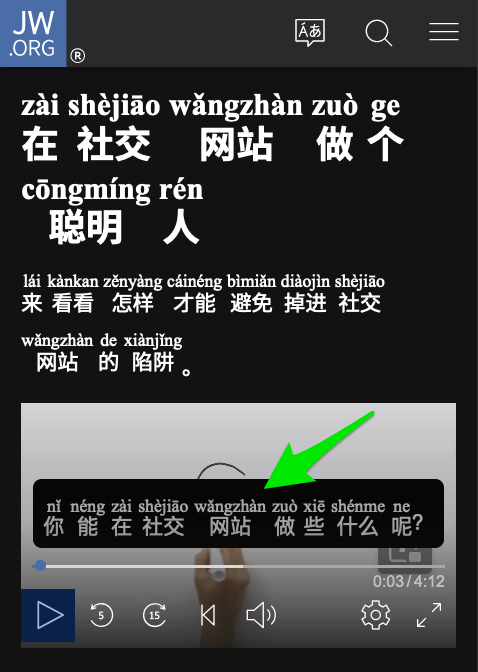
Screenshot of a Mandarin video on jw.org, in Firefox, after processing by the RTE _Pīnyīn_ bookmarklet, with an arrow pointing out the _Pīnyīn_ added to the subtitles


Comments are enabled on this blog, so if you are so inclined, comment away!


A news feed for this blog is available here.


Tuesday, May 16, 2023

MEotW: Shàngtiān

The Mandarin Expression of the Week is:

What Mandarin expressions might Chinese people of the world think of when they think of “God”?


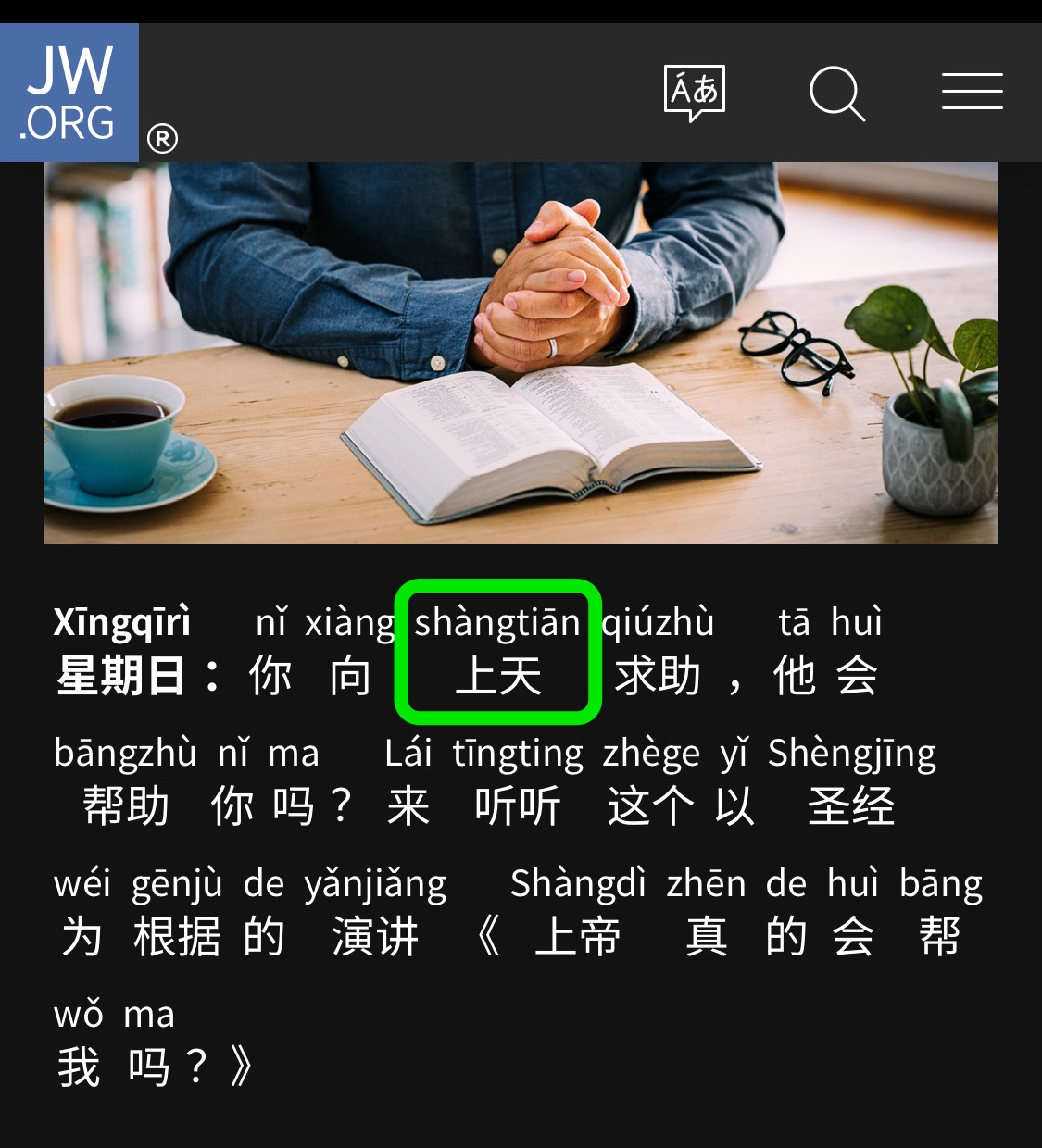
“Shàngtiān” used on jw.org, on the page inviting people to attend the 2023 convention


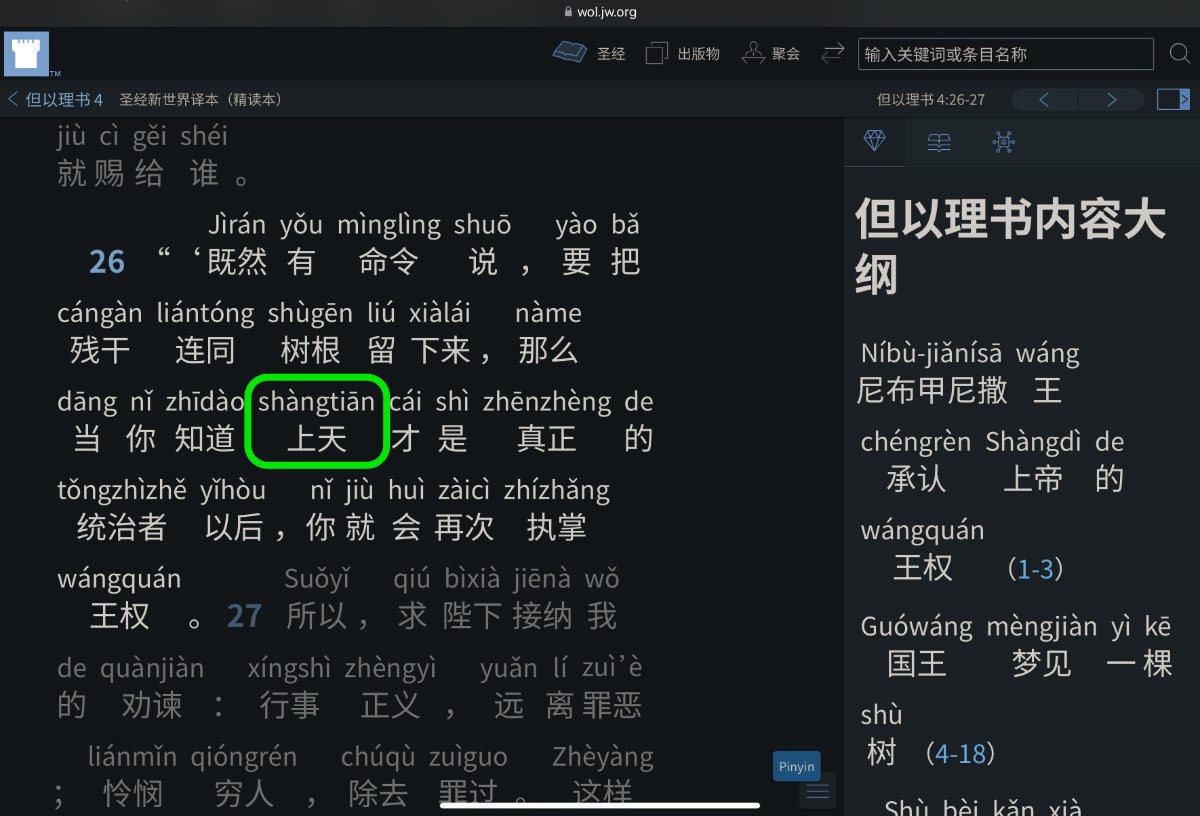
“Shàngtiān” in Daniel 4:26 (NWT (nwtsty), WOL CHS+Pinyin)


(Dark mode for the Watchtower ONLINE LIBRARY (WOL) website, as shown in the above image, can be enabled in the Safari web browser by using the Noir Safari extension.)


Comments are enabled on this blog, so if you are so inclined, comment away!


A news feed for this blog is available here.


Wednesday, May 10, 2023

MEotW: shěnpàn

The Mandarin Expression of the Week is:

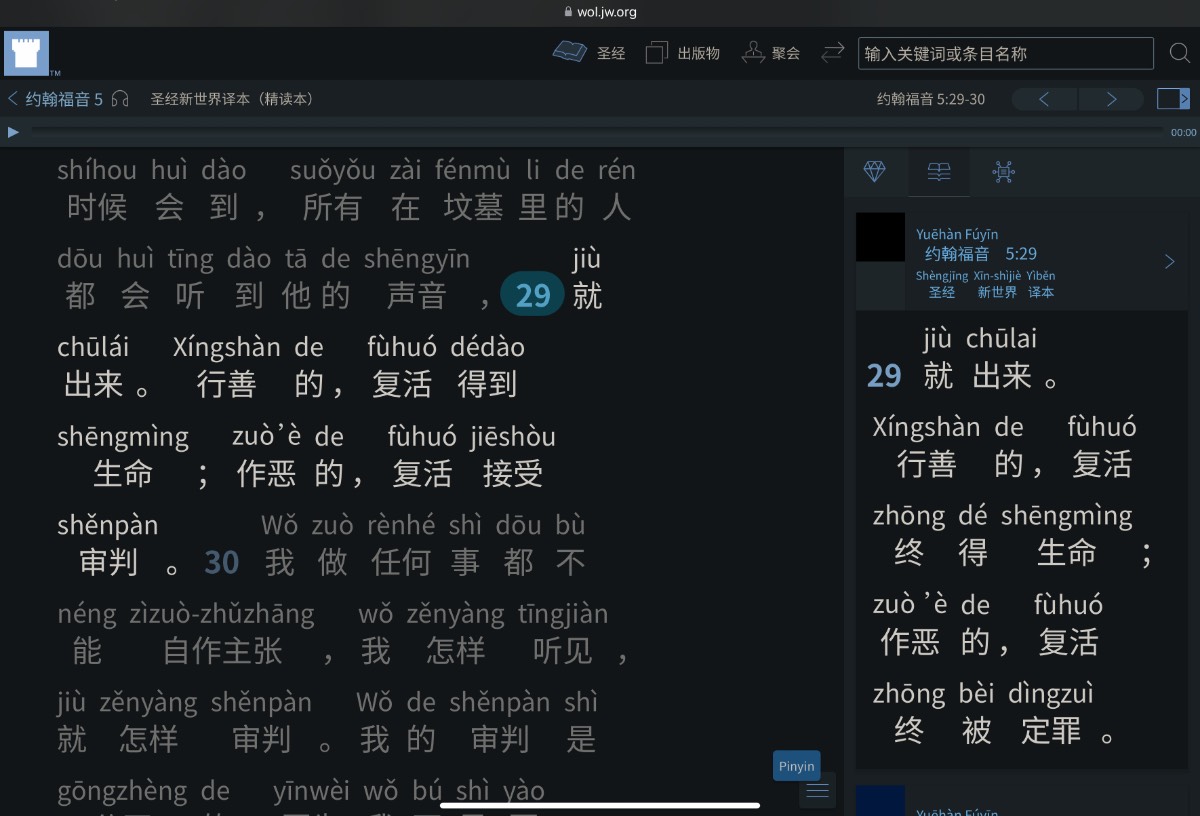
How does the 2023 Mandarin NWT Bible’s new translation of John 5:29 harmonize with our new understanding of this scripture?


John 5:29 (WOL CHS+Pinyin Parallel Translations)


(Dark mode for the Watchtower ONLINE LIBRARY (WOL) website, as shown in the above image, can be enabled in the Safari web browser by using the Noir Safari extension.)


Comments are enabled on this blog, so if you are so inclined, comment away!


A news feed for this blog is available here.


Tuesday, April 25, 2023

MEotW: jiùsuàn

The Mandarin Expression of the Week is:

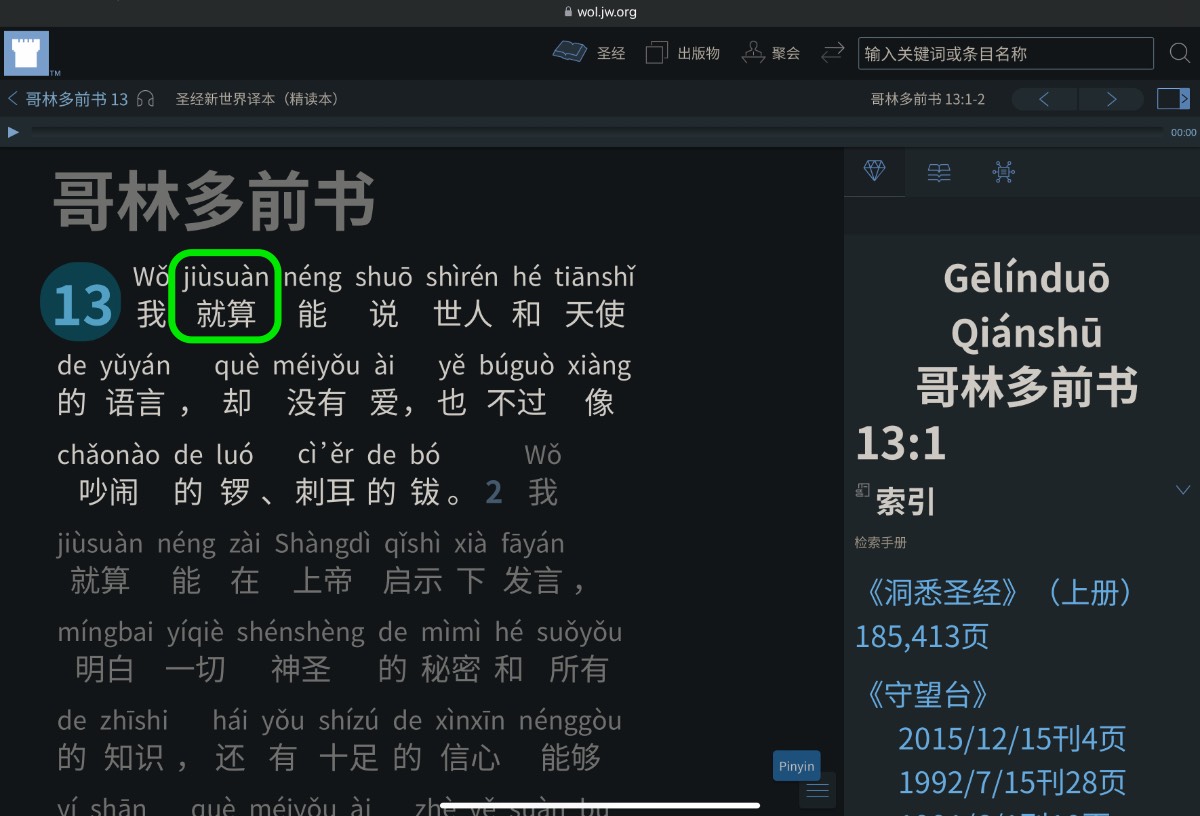
What if we could speak Mandarin fluently, and knew all the Chinese characters? Is that all we need in the Mandarin field?


Screenshot of “jiùsuàn” in 1 Co. 13:1 (nwtsty, CHS+_Pīnyīn_ WOL)


(Dark mode for the Watchtower ONLINE LIBRARY (WOL) website, as shown in the above image, can be enabled in the Safari web browser by using the Noir Safari extension.)


Comments are enabled on this blog, so if you are so inclined, comment away!


A news feed for this blog is available here.


Friday, April 07, 2023

Updated Font Files for Pīnyīn Plus Resources

Back in 2014, the post “New Typeface for Pīnyīn and Pīnyīn-English Material” on this blog discussed the adoption of the typeface Gentium Basic for the Pīnyīn and Pīnyīn-English material that existed at the time.


As explained on the Gentium website, Gentium Plus is an expanded version of Gentium Basic. It seems that Gentium Plus will be the focus of future development work for the Gentium typeface family. Recently, a new version of Gentium Plus was released, and this has now been adopted on all existing Pīnyīn Plus resources. As a reminder, the short link listing all existing Pīnyīn Plus resources is:

Besides benefiting from design improvements, Gentium Plus is also available in the WOFF2 format, which uses advanced compression to reduce font file sizes, resulting in the font files downloading faster. To further improve download speeds, the Gentium Plus font files now used in the Pīnyīn Plus resources have also undergone font subsetting, which involves removing information for glyphs (characters of symbols) and/or font features that are not required. The resulting subsetted WOFF2 Gentium Plus font files weigh in at only about 131 KB in total, meaning that they can be downloaded in about 20% of the time required for the modified Gentium Basic font files (about 667 KB) that the current Gentium Plus files replaced, and in about 13% of the time required for the original Gentium Basic font files (about 1 MB).


While users with relatively new devices and fast Internet connections may not notice much of a difference, users with older devices and/or relatively slow Internet connections should especially benefit from the Pīnyīn Plus web pages downloading and rendering more quickly. This especially applies when these pages are loaded for the first time, before web browser file caching can take effect.


Friday, September 23, 2022

Safari Extension for Adding Pīnyīn, etc. to Web Pages

In addition to the existing Android-based solutions for adding Pīnyīn, etc. to web pages with Chinese characters, the following Safari extension that works on Apple mobile devices is now available, and has been added to the list on tiandi.info/apps:

  • Chinese words separator
    (Safari web browser extension,
    iOS/iPadOS 15.0 or later required,
    “Color, space, pinyin, zhuyin/bopomofo, tone, HSK for Chinese words. Dictionary: read more, hover less with sentence dictionary. Convert between Traditional and Simplified characters.”)
  • Short Link:
    tiandi.info/apps

BTW, this extension also works on Safari on Mac computers (macOS 12.0 or later required).


I have been informed that this extension is available for free until September 25; I have no information about what the price will be after that.


Friday, January 27, 2017

New Resource: Pīnyīn Plus Expressions Web Page

Recent discussions with users have prompted me to develop a new type of material for language-learners in the Mandarin field. I am calling it Pīnyīn Plus material.


Pīnyīn Plus material focuses on helping publishers learn Mandarin speech, the primary language skill required in the Mandarin field. (1 Co. 14:8–11) Pīnyīn Plus material provides the language-learning and memory-strengthening benefits of flashcards, and integrates these benefits into the context of a publication’s Mandarin text, in the style of augmented reality (AR).


As I have been producing Pīnyīn Plus material, I have been compiling a collection of the Pīnyīn Plus expressions I have come across. This helps to speed up the production of the Pīnyīn Plus material. Now, this ever-growing collection of Pīnyīn Plus expressions is also available on the web in this mobile-friendly dictionary-like resource:

  • Pīnyīn Plus Expressions (Web)
    proofread, mobile-friendly,
    flashcards integrated with the text,
    English translations with
    literal & effective meanings,
    Simplified & Traditional characters,
    sorted mainly by Pīnyīn,
    links for index headings,
    (Your browser’s Find feature
    can also be used to search by Pīnyīn.
    To search by English or characters,
    first tap/click on 📖 Show All.)
    Night Theme that can be turned on or off
    using the ☀️/🌙 button at the top right,
    adjustable text size
  • Short Links:
    LinksVocabulary Lists
    Pīnyīn Plus Expressions Link (tiandi.info/pyp)

Here is a link to some information about the thinking behind the design of Pīnyīn Plus material:

Friday, October 14, 2016

Pīnyīn-English Expressions Web Resource Updated and Rearchitected

The Pīnyīn-English Expressions web resource has been updated with new expressions and various other revisions resulting from recent Pīnyīn-English material production. Also, due to very slow loading in iOS 10, the single web page (which allowed global searching with a browser’s Find feature) has been divided into multiple faster-loading web pages:


Tuesday, June 14, 2016

Pīnyīn-English Expressions Web Page Updated

The Pīnyīn-English Expressions web page has been updated with new expressions and various other revisions resulting from recent Pīnyīn-English material production:

Tuesday, April 26, 2016

Pīnyīn-English Expressions Web Pages Updated

The Pīnyīn-English Expressions web pages have been updated with new expressions and various other revisions resulting from recent Pīnyīn-English material production:

Tuesday, April 12, 2016

Pīnyīn-English Expressions Web Pages Updated

The Pīnyīn-English Expressions web pages have been updated with new expressions and various other revisions resulting from recent Pīnyīn-English material production:

Tuesday, April 05, 2016

Pīnyīn-English Expressions Web Pages Updated

The Pīnyīn-English Expressions web pages have been updated with new expressions and various other revisions resulting from recent Pīnyīn-English material production:

Monday, March 21, 2016

Pīnyīn-English Expressions Web Pages Updated

The Pīnyīn-English Expressions web pages have been updated with expressions encountered in recent Pīnyīn-English material production:

Saturday, March 19, 2016

New Resources: Pīnyīn-English Expressions Web Pages

As I have been producing Pīnyīn-English material for various publications, I have been compiling a collection of the Pīnyīn-English expressions I have come across in them. This helps to speed up the production of the Pīnyīn-English material. Now, this ever-growing collection of Pīnyīn-English expressions is also available on the web in these mobile-friendly dictionary-like resources:

Thursday, August 28, 2014

Good News Br. Pīnyīn-English Web Material Up to Lesson 4, Question 3 Added

Good News brochure Pīnyīn-English web material up to Lesson 4, Question 3, including the full text of the cited scriptures, has been added to:

Note that:

  • The material in the above resources has been carefully translated, rendered, and proofread.
  • The linked full text in Pīnyīn-English of all the cited scriptures is included in the above resources.
  • The above resources are mobile-friendly—they are quite legible and usable on everything from desktop/laptop PCs and Macs to iPads and other tablets to iPhones and other smartphones.
  • The Recommended Browsers: sections in the above resources contain information about how to get the best viewing experience.
  • In the above resources, links are used extensively to make it quick and easy to get around in the material, drastically reducing the amount of manual scrolling needed.
  • The above resources contain picture links.
  • The above resources contain a link to the video “Shàngdì Yǒu Míngzi ma?” (“Does God Have a Name?”) on jw.org.
  • Besides being viewable online, the web pages can also be downloaded and used offline. Of course, they can be printed out from your web browser as well. (More details are included in their Offline Viewing and Printing sections.)
  • For your convenience, a short link is available for the above resources.

Also, the introductions explain why it’s good to use Pīnyīn as a writing system on its own.


Friday, August 22, 2014

Good News Br. Pīnyīn-English Web Resources Re-architected

The Good News br. Pīnyīn-English web resources have been re-architected so that each is made up of several files and folders, rather than one big web page. While the one-page format made some things easier, it also made other things harder. Breaking up each of these web resources into several files and folders will help with those things, but mainly, it will make page loading much quicker, especially as the contents of these web resources get filled out in the days ahead. To keep scripture lookups speedy, the text of the scriptures has been kept on the same web page as the referring links, in the section entitled References. Also, the text of footnotes has been moved out of the main body’s text flow and into the References section of the web page its referring links are on.


This re-architecting has required changing the web addresses of the Good News br. Pīnyīn-English web resources. Here are the updated links:

(The referring link pages at tiandi.info and 3lines.org have been updated as well.)


Also, as discussed here, the default typeface for the above resources has been changed to Gentium Basic, and adjustments have been made to letterspacing as required by the ruby text structure of the material.


Note that:

  • The material in the above resources has been carefully rendered and proofread.
  • The linked full text in Pīnyīn-English of all the cited scriptures is included in the above resources.
  • The above resources are mobile-friendly—they are quite legible and usable on everything from desktop/laptop PCs and Macs to iPads and other tablets to iPhones and other smartphones.
  • The Recommended Browsers: sections in the above resources contain information about how to get the best viewing experience.
  • In the above resources, links are used extensively to make it quick and easy to get around in the material, drastically reducing the amount of manual scrolling needed.
  • The above resources contain picture links.
  • The above resources contain a link to the video “Shàngdì Yǒu Míngzi ma?” (“Does God Have a Name?”) on jw.org.
  • Besides being viewable online, the web pages can also be downloaded and used offline. Of course, they can be printed out from your web browser as well. (More details are included in their Offline Viewing and Printing sections.)
  • For your convenience, a short link is available for the above resources.

Also, the introductions explain why it’s good to use Pīnyīn as a writing system on its own.


Thursday, June 12, 2014

New Typeface for Pīnyīn and Pīnyīn-English Material

After much research and consideration, I have decided to change the default typeface for the Pīnyīn and Pīnyīn-English material from Helvetica Neue/Arial to Gentium Basic. (Helvetica Neue, Helvetica, Arial, and “sans-serif” will be set as the fallback typefaces.)


Some reasons for this are:

  • While Helvetica Neue, Arial, etc. would be rendered using local font files (ones residing on the client device itself), the Gentium Basic font files will be served from a web server. This will help eliminate dependence on certain font files (and certain versions of those font files) being available on users’ devices.
  • Most modern web browsers now support this capability, making it workable for web users.
  • With the right programming code, EPUB files can also support included font files.
  • Gentium Basic’s licence allows for such usage for free, whereas the licences of Helvetica Neue, Arial, etc. do not.
  • Increased certainty about what font file will be used to render certain material makes it more certain that that material will be rendered properly on users’ devices—that certain things will line up properly, etc.
  • Helvetica Neue, Arial, etc. have a clean, neutral appearance that many like (Interestingly, “Helvetica” means “Swiss” in Latin.), but Gentium Basic should prove to be more readable. For example, it makes it easier to tell similar-looking characters apart from one another, such as “i”, “I”, and “l”.
  • The website of Gentium Basic’s designer has information that shows that he has thought and researched deeply about the design of diacritics, which is what Pīnyīn tone marks are. Indeed, the increased size and clarity of Gentium Basic’s Pīnyīn tone marks should especially help to make Pīnyīn text easier to read.
  • While Helvetica Neue, Arial, etc. can seem a little sterile, Gentium Basic has a more “artful”, yet friendly style. Hopefully this will make the Pīnyīn and Pīnyīn-English material even more appealing.

Some Pīnyīn and Pīnyīn-English material has already been converted to use the Gentium Basic typeface, and eventually more of it will be so converted.


Friday, May 30, 2014

Good News Brochure Pīnyīn-English Web Material For All of Lesson 3 Added

Good News brochure Pīnyīn-English web material for all of Lesson 3, including the full text of the cited scriptures, has been added to:

Note that:

  • The material in the above resources has been carefully rendered and proofread.
  • The linked full text in Pīnyīn-English of all the cited scriptures is included in the above resources.
  • The above resources are mobile-friendly—they are quite legible and usable on everything from desktop/laptop PCs and Macs to iPads and other tablets to iPhones and other smartphones.
  • The Recommended Browsers: sections in the above resources contain information about how to get the best viewing experience.
  • In the above resources, links are used extensively to make it quick and easy to get around in the material, drastically reducing the amount of manual scrolling needed.
  • The above resources contain picture links.
  • Besides being viewable online, the web pages can also be downloaded and used offline. Of course, they can be printed out from your web browser as well. (More details are included in their Offline Viewing and Printing sections, which include a link to a special PDF file for printing out the content of the web pages.)
  • For your convenience, a short link is available for the above resources.

Also, the introductions explain why it’s good to use Pīnyīn as a writing system on its own.


Thursday, April 10, 2014

Good News Brochure Pīnyīn-English Web Material Up to Lesson 3, Question 2 Added

Good News brochure Pīnyīn-English web material covering up to Lesson 3, Question 2, including the full text of the cited scriptures, has been added to:

Note that:

  • The material in the above resources has been carefully rendered and proofread.
  • The linked full text in Pīnyīn-English of all the cited scriptures is included in the above resources.
  • The above resources are mobile-friendly—they are quite legible and usable on everything from desktop/laptop PCs and Macs to iPads and other tablets to iPhones and other smartphones.
  • The Recommended Browsers: sections in the above resources contain information about how to get the best viewing experience.
  • In the above resources, links are used extensively to make it quick and easy to get around in the material, drastically reducing the amount of manual scrolling needed.
  • The above resources contain picture links.
  • Besides being viewable online, the web pages can also be downloaded and used offline. Of course, they can be printed out from your web browser as well. (More details are included in their Offline Viewing and Printing sections, which include a link to a special PDF file for printing out the content of the web pages.)
  • For your convenience, a short link is available for the above resources.

Also, the introductions explain why it’s good to use Pīnyīn as a writing system on its own.


Friday, March 21, 2014

2014-03-20 Beta Links File Update Released

As mentioned below, I am now focusing on using the tiandi.info/links-based short links, this Links News blog, and the @TiandiLinksNews Twitter account for directing people to Chinese field resources from our fellow workers.


For those who would like to also use the Links file, though, the 2014-03-20 Beta Links file update has been released. As of this writing, I am in the process of sending to those on the Links file updates mailing list an email with directions on how to obtain this updated file. It’s taking a while, because the mailing list has grown over the years to contain thousands of email addresses, and I’m running up against measures meant to slow down spammers. (Email spammers—a definite example of why we can’t have nice things in this old system, and of why we need the new system!) If you are on the Links file updates mailing list but have not received this email yet, please give it a bit more time. Or, if you already know where the download page is and what the password is (they are unchanged from before), then you don’t have to wait for the email to get this Links file update.


If you haven’t already done so, I recommend that you read the included directions.html file before proceeding to use the Links file. Besides including instructions and examples on how to use the Links file, the directions.html file also discusses the redistribution of the Links file.


The Links file is used by downloading its ZIP file from the web page linked to in the email, extracting it with the supplied password, saving it to a drive, and opening it in a modern web browser like Safari, Chrome, Opera, Firefox, or Internet Explorer. After you open it, you may want to bookmark it or add it to your Favorites for easy retrieval later on.


To aid navigation, the Launchpads near the top of the Links file act as big buttons that take you directly to certain key headings in the Index. Also, the Navpads (navigation pads) that stay on the right of the Links file can be used to jump to major sections of the file.


Please note the following introductory comments that are included in this version of the Links file:

PLEASE NOTE:

Please delete any old Links files that you have and replace them with this one.

This is a beta (prototype) version of an update to the Links file. It has more information than previous versions, and it no longer has any links pointing to the chinesetools . net site, which unfortunately has been redirected to an apostate site by the former fellow worker who owns it. However, this version of the Links file is still unfinished, by the standard I held previous versions to, and it is not fully up-to-date.

Also, note that while some of the resources that used to be hosted on the chinesetools . net site have been recreated elsewhere, not all of them have been.

The Links file was meant to be an indexed, relatively comprehensive listing of the Chinese field resources made available by our fellow workers. It was conceived of at a time when it was inadvisable to post such a resource on the open web, so it came to be implemented as a file that would be downloaded in a password-protected ZIP file and then opened from one’s own computer, rather than visited on the web. It seems to have helped many people over the years, and for that I am glad. However, over time, the situation has changed, with the acceptance of the 3lines.org site and with the ever-expanding nature of the Chinese field and the resources available for it. In view of such developments, it seems that trying to maintain the Links file according to its original purpose and in its recent form (which has gotten quite large, complex, and monolithic) is no longer the best way for me to use my limited time and energy to help those in the Chinese field.

Going forward, I will be focusing on the following resources for directing people to Chinese field resources from our fellow workers: