MEotW: nándào
The Mandarin Expression of the Week is:
How can we ask rhetorical questions in Mandarin?
Comments are enabled on this blog, so if you are so inclined, comment away!
A news feed for this blog is available here.

The Mandarin Expression of the Week is:
How can we ask rhetorical questions in Mandarin?
Comments are enabled on this blog, so if you are so inclined, comment away!
A news feed for this blog is available here.
The Mandarin Expression of the Week is:
How can we talk to people in Mandarin about whether economic reform can bring world peace?
Comments are enabled on this blog, so if you are so inclined, comment away!
A news feed for this blog is available here.
The Mandarin Expression of the Week is:
What different expressions are used in the Mandarin NWT Bible to refer to different kinds of peace?
Comments are enabled on this blog, so if you are so inclined, comment away!
A news feed for this blog is available here.
The Mandarin Expression of the Week is:
How could we reply to a Mandarin-speaking person who says that the idea of a world without war is just a fairy tale?
Comments are enabled on this blog, so if you are so inclined, comment away!
A news feed for this blog is available here.
The Mandarin Expression of the Week is:
For us Mandarin field language learners, do all language-learning “roads” lead to the same place?
Comments are enabled on this blog, so if you are so inclined, comment away!
A news feed for this blog is available here.
The Mandarin Expression of the Week is:
Why should Mandarin field language learners be wary of what the world’s education system teaches people about Chinese characters?
Comments are enabled on this blog, so if you are so inclined, comment away!
A news feed for this blog is available here.
The Mandarin Expression of the Week is:
What are some Mandarin expressions that could we use to discuss the ongoing Gaza-Israel conflict, and how could we use them?
Comments are enabled on this blog, so if you are so inclined, comment away!
A news feed for this blog is available here.
The Mandarin Expression of the Week is:
What are some ways in which the organization has translated “spiritual war/warfare” into Mandarin in recent years?
Comments are enabled on this blog, so if you are so inclined, comment away!
A news feed for this blog is available here.
The Mandarin Expression of the Week is:
How might our enemies in the spiritual war be viewing aspects of the worldwide Mandarin field such as the Great Wall of characters?

Comments are enabled on this blog, so if you are so inclined, comment away!
A news feed for this blog is available here.
The Mandarin Expression of the Week is:
How does the 2023 Mandarin NWT Bible’s new translation of John 5:29 harmonize with our new understanding of this scripture?
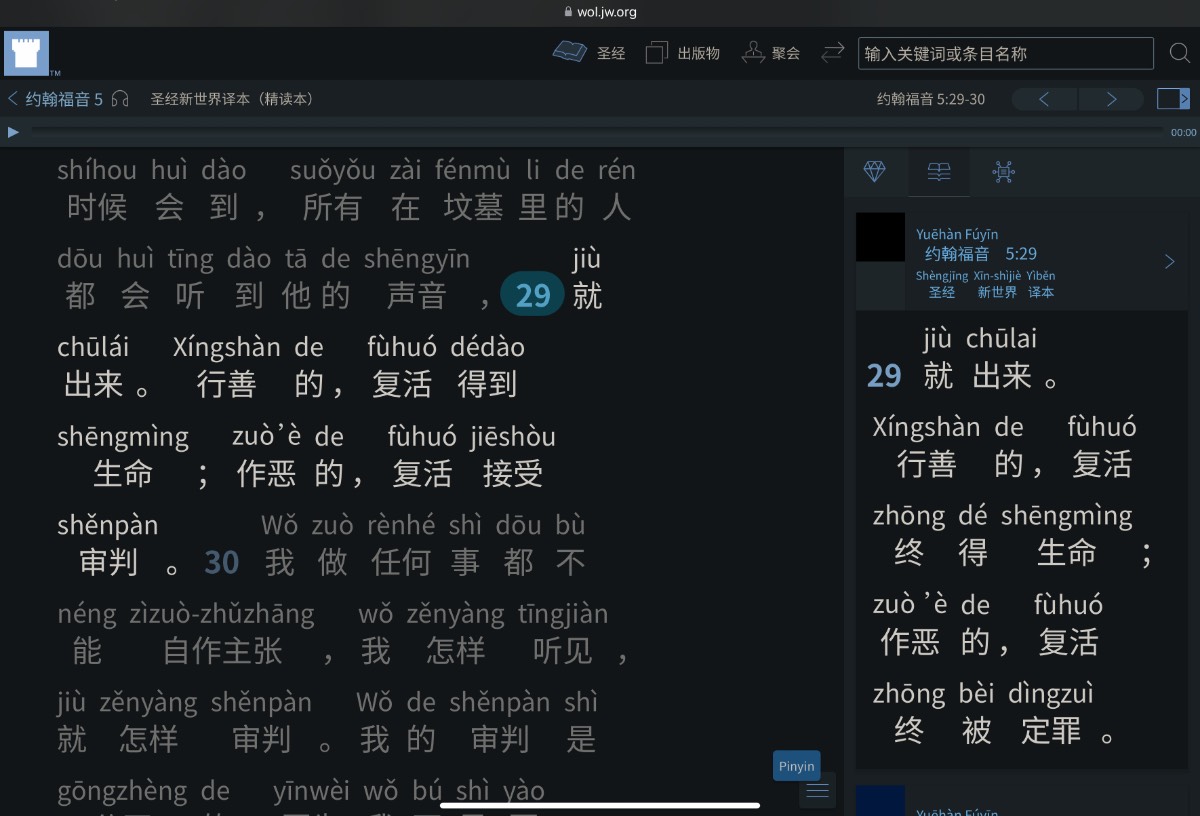
(Dark mode for the Watchtower ONLINE LIBRARY (WOL) website, as shown in the above image, can be enabled in the Safari web browser by using the Noir Safari extension.)
Comments are enabled on this blog, so if you are so inclined, comment away!
A news feed for this blog is available here.
The Mandarin Expression of the Week is:
Is it really inconceivable that Chinese characters are not always necessary for reading and writing Mandarin?
Comments are enabled on this blog, so if you are so inclined, comment away!
A news feed for this blog is available here.
If you use Twitter, have you checked out the Twitter account for this blog, and for the tiandi.info and Mandarin Expression of the Week blogs? Not only does it provide notifications about posts on these blogs, it’s also a place for short thoughts that don’t fit into any of these blogs, but that fit with them in spirit. For example:
Honour Jehovah God first. Don’t honour mere human cultural traditions first, no matter how proud that human culture is.
— tiandi, Links News (@TiandiLinksNews) December 14, 2020
Actually, the more proud and arrogant a human culture is before God, the less we should honour it.
One Bible study I had whose mother tongue was Mandarin had previously studied with the English-speaking brothers for 10 years. He wanted to get baptized, but the elders found he wasn’t clear on the immortal soul! I studied that with him in Mandarin for just 1 hour and he got it.
— tiandi, Links News (@TiandiLinksNews) December 13, 2020
There is a link to this Twitter account in the CHINESE FIELDS LINKS section at the top right of this blog’s web pages.
To follow the Twitter account for this blog, and for the tiandi.info and Mandarin Expression of the Week blogs, tap or click on this button:
Do you have any comments or questions on the above-mentioned blogs and Twitter account? Are there any other platforms that you would like to see related content on, like Instagram, etc.? Let me know by email or on Twitter!
Official Pīnyīn web material is now available on jw.org for certain publications.
To see if such material is available on jw.org for a certain publication, follow this path:
When a web page of text for that publication is loaded, a 显示拼音 checkbox will appear near the top of that page if Pīnyīn web material is available for it. (“显示拼音 (Xiǎnshì Pīnyīn)” means “Show Pīnyīn”.) Checking that checkbox will immediately cause Pīnyīn ruby text to appear over the Chinese characters on that web page. The setting will be “remembered” by your web browser for web pages like that web page.
Related information will be added to the affected short links as time allows.
This article has been revised:
Here are a couple of excerpts from the revised article:
…Indeed, those who have expended much time and effort to learn some characters may find that they can understand those “gateway characters” faster when they see them, compared to when they see Pīnyīn. This is because while characters and Pīnyīn are both systems for visually representing Mandarin words and their meanings, Pīnyīn represents meaning indirectly by first simply and directly representing invisible Mandarin speech sounds, which in turn represent meaning (1 Corinthians 14:10, quoted above), whereas characters make some attempt to represent meaning directly through their visual designs, resulting in a short circuit.
However, just as a short circuit is not a good thing to have in an electrical circuit, relying on characters trying to directly represent meaning visually is not a good thing to do for those of us who are learning Mandarin for the Mandarin field. Why? The reason is that, just like it’s an established fact that the earth is round, according to modern linguistics (the scientific study of language) this is also an established fact: “Speech is primary, writing is secondary and is always derivative of speech.” This scientific truth about language, that Jehovah built us and wired us to primarily represent meaning through speech, supports what 1 Corinthians 14:8–11 (quoted above) says about understandable speech being of prime importance to Christian evangelizers. …
…
There is of course some value in learning a reasonable number of characters, since they are so pervasive in the Chinese world. However, characters can gradually be learned later, if desired, when we actually have time for the diversion that they entail.
If we were to compare Mandarin language ability to a building, then ability with Mandarin speech would be the building’s foundation and basic structure. Pīnyīn is an excellent tool for helping to build good, solid ability with Mandarin speech, which makes for a good, solid foundation and a good, solid basic structure for Mandarin language ability. Knowledge of characters, though, at best would be decorative or fashionable exterior paint, siding, trim, etc. that is visible on the outside. First prioritizing fashionable, visible characters can thus lead to Mandarin language ability that does not stand up well to real-world usage because of lacking a strong foundation and a good basic structure. In contrast, children in China generally have a good foundational knowledge of Mandarin speech before they learn characters, and they continue to learn and constantly use Mandarin speech even as they learn characters.
So, for each of us language learners in the Mandarin field, the first priority should be to learn Mandarin speech. This will enable us to actually understand and benefit from Mandarin meetings, and it will enable us to actually talk to Mandarin-speaking people in Mandarin from the heart. It will also make it easier for us to gradually learn characters later, as time allows.
[Update 2018-08-16: Since this article is no longer accessible from 3lines.org, references to 3lines.org have been removed, and the article link has been updated.]
This article has been revised:
Here is a paragraph that was added:
Sadly, that “faith follows the thing heard” is made painfully obvious by how, occasionally, publishers leave the Mandarin field (or even leave the truth) because they’re not getting the spiritual nourishment they need from the Mandarin meetings—since they’re not understanding what they hear, their faith is not getting built up. Rather than successfully continuing to help out, such ones instead become spiritual casualties on the Mandarin front of the spiritual war we are fighting. (2 Corinthians 10:4, 5) Learning characters does not fix this—publishers need to learn to understand Mandarin speech to benefit spiritually from Mandarin meetings, because the talks, comments, etc. at such meetings are made of Mandarin speech, not characters. In fact, focusing on characters makes this problem worse because it makes learning Mandarin speech harder and slower. At the very least, it distracts from learning Mandarin speech.
Some Chinese field resource pages that went offline because of some glitch at shaw.ca have been restored. These pages are:
Official pinyin book files have become available for download on jw.org. Previously, the only pinyin publications available for download there were the pinyin Watchtowers. Now, PDF files for the pinyin versions of the Sing to Jehovah, Bible Teach, and Bearing Witness books are available as well.
More information and commentary on this historic development can be found in a new post at tiandi.info.
To obtain the login information for tiandi.info, request e-mail notification of news regarding available resources, or if you have any questions or comments, you may e-mail me at waynerj@shaw.ca, providing information such as what group or congregation you’re with, who referred you to this site, etc.
...is the title of a new post at tiandi.info. Here’s the description from the news feed:
A worldly pinyin expert feels “amazement” at the quality and the quantity of the pinyin material available via the official pinyin editions of The Watchtower.
To obtain the login information for tiandi.info, request e-mail notification of news regarding available resources, or if you have any questions or comments, you may e-mail me at waynerj@shaw.ca, providing information such as what group or congregation you’re with, who referred you to this site, etc.
The post “Necessity, Invention, and Skunkworks”, posted at tiandi.info a few hours ago, has just been revised to include some discussion about MEPS. Check it out!
To obtain the login information for tiandi.info, request e-mail notification of news regarding available resources, or if you have any questions or comments, you may e-mail me at waynerj@shaw.ca, providing information such as what group or congregation you’re with, who referred you to this site, etc.
...is the title of a new post at tiandi.info. Here’s the description from the news feed:
The mother, births, upbringings, and adoptions of inventions in the Chinese field.
To obtain the login information for tiandi.info, request e-mail notification of news regarding available resources, or if you have any questions or comments, you may e-mail me at waynerj@shaw.ca, providing information such as what group or congregation you’re with, who referred you to this site, etc.