Showing posts with label mobile apps. Show all posts

Sunday, May 04, 2025

MEotW: zìxué‐chéngcái

The Mandarin Expression of the Week is:

Does being self-taught as a Mandarin field language learner need to lead to impostor syndrome?


Comments are enabled on this blog, so if you are so inclined, comment away!


A news feed for this blog is available here.


Friday, September 29, 2023

BREAKING NEWS: The Latest Update of the JW Library App Supports Pīnyīn


At the time of this writing, the JW Library page on Apple’s App Store and the JW Library page on the Google Play store both show this new version 14.1, dated September 29, 2023, as being available in my location. (Due to the technical challenges involved in making apps available for download worldwide, an app version may become available in different parts of the world at slightly different times.) Pīnyīn thus becoming available in the JW Library app is good news for us Mandarin field language learners, since it represents additional ongoing real-world official support for us from Jehovah’s organization!


Friday, September 23, 2022

Safari Extension for Adding Pīnyīn, etc. to Web Pages

In addition to the existing Android-based solutions for adding Pīnyīn, etc. to web pages with Chinese characters, the following Safari extension that works on Apple mobile devices is now available, and has been added to the list on tiandi.info/apps:

  • Chinese words separator
    (Safari web browser extension,
    iOS/iPadOS 15.0 or later required,
    “Color, space, pinyin, zhuyin/bopomofo, tone, HSK for Chinese words. Dictionary: read more, hover less with sentence dictionary. Convert between Traditional and Simplified characters.”)
  • Short Link:
    tiandi.info/apps

BTW, this extension also works on Safari on Mac computers (macOS 12.0 or later required).


I have been informed that this extension is available for free until September 25; I have no information about what the price will be after that.


Wednesday, March 10, 2021

The Pinyin Typist App Has Been Updated

The Pīnyīn Typist iOS/iPadOS app has been updated with support for the latest iPhones and iPads. Check it out!
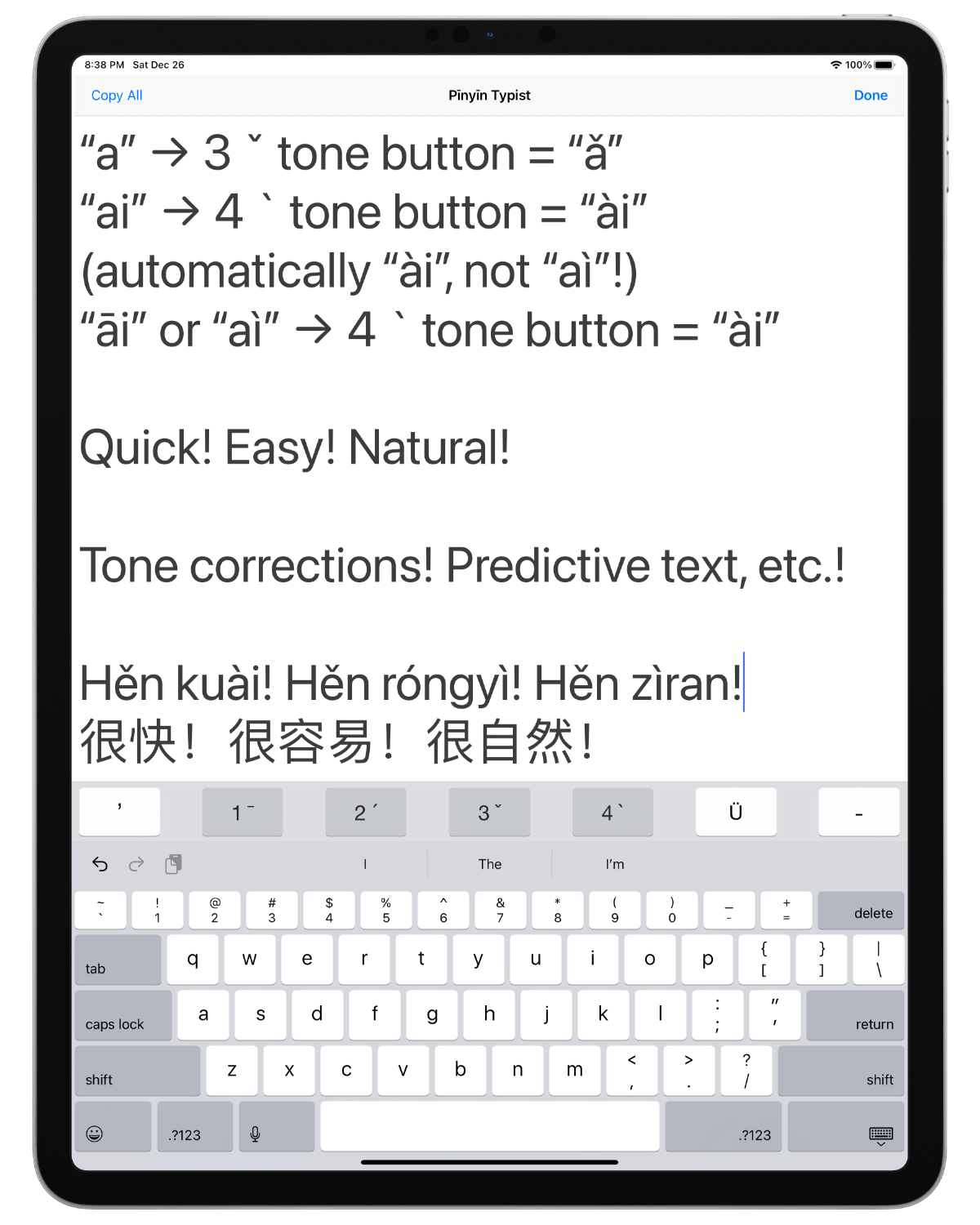

Pinyin Typist app screenshot

[Full disclosure: I am the developer of this app. That said, I sincerely believe it is one of the best ways, perhaps even the very best way, to quickly and easily type exactly the Pīnyīn you want on an iPad, iPhone, or iPod touch, especially if you want to type a lot of Pīnyīn, e.g., for a talk. For us language learners and teachers in the Mandarin field, this is a valuable capability to have.]

What’s New

NOTE: Progressing Apple technologies required the code for saving snippets to be rewritten. Everything has been working perfectly in testing, but if you have many snippets saved in Pīnyīn Typist, you may want to back some or all of them up elsewhere before installing this update of Pīnyīn Typist.

  • Support for recent iPhones and iPads and Apple software technologies has been added or improved.
  • iOS 11 or above is now required.
  • The bug where sometimes in the Pīnyīn Typing tab view the software keyboard covered the lower part of the text view has been addressed.
  • On iOS/iPadOS 13 or above, hardware keyboard ⌨️ shortcuts are now available. (When a hardware keyboard is connected to your iPad, holding down one of the Command (⌘) keys will display a list of the available hardware keyboard shortcuts.)
  • The current system font (San Francisco) is now the default font, and it is now one of the available options to be the Pīnyīn Typing tab view font.
  • Command names have been revised for improved clarity and consistency.
  • An optional warning alert has been added for the Delete All command.
  • Other bug fixes and improvements

Not for Entering Characters?!

THIS APP IS NOT AN ALTERNATIVE WAY TO TYPE CHINESE CHARACTERS—it supports the standard iOS/iPadOS ways of typing characters.


There have long been built-in ways to type Chinese characters on iOS, Windows, macOS, etc., but when the iPhone and iPad were introduced, there was no way to type Pīnyīn with tone marks on them. The Pinyin Typist app was developed as the first app to provide this capability that is important and useful to Mandarin language learners and teachers.


While many in the world–and some in the Mandarin field—only care about characters and look down on Pīnyīn, the truth is that Pīnyīn works well as a simple full writing system for Mandarin, for anyone who can overcome the pressures from mere human traditions that dictate the use of characters, and who can overcome the prejudice with which many unfortunately thus view Pīnyīn.


Not Free?!

When Jesus said “you received free, give free”, he was specifically referring to the Kingdom message that we preach. (Matthew 10:8) It would not be appropriate to take these words to mean that Jesus’ followers should expect that their fellow workers must give them general-purpose tools or resources for free—some among Jesus’ followers may decide to do so in certain circumstances, but they are not under any obligation to do so.


For example, it’s true that some general-purpose items like sandals were particularly useful to first-century evangelizers as they carried out their ministry, but that doesn’t mean that Christians who made sandals were obligated to always give their fellow Christians free sandals! Similarly, while some general-purpose things like cars, shoes, and general-purpose apps like Microsoft Word and Pinyin Typist may be particulary useful to us modern-day evangelizers as we carry out our ministry, that doesn’t mean that we should expect fellow Christians who deal in cars, shoes, or general-purpose apps to always give us such things for free. Note that soon after Jesus said regarding the Kingdom message that “you received free, give free”, he cited the general principle that “the worker deserves his food”.—Matthew 10:10.


In my case, as the developer of Pinyin Typist, getting paid for the work I put into Pinyin Typist helps me to pay for the food, etc. that I need in order to keep on maintaining and improving, not only Pinyin Typist, but also the free language-learning resources that I produce for language learners in the Mandarin field. Without sufficient income from Pinyin Typist or other apps that I may develop part-time, I may be forced to take other work that would likely reduce the amount of time and effort I can spend on free language-learning resources for the Mandarin field.

Not Just $1?!

It is unfortunate that the culture of the App Store has become such that many people expect apps to be free, or at most, to only cost $1. Developing apps, especially good apps, actually takes a lot of time and a lot of work, so joining in a culturally mandated “race to the bottom” is simply unsustainable for many app developers. While I am not personally acquainted with the circumstances, one possible example of this is that for a while, a brother had a pretty good free app on the App Store for typing Pīnyīn, called Pure Pinyin. However, this app is no longer available on the App Store.


In contrast to the prevailing culture in the world of people not being willing to pay for apps that could serve them well for years, many publishers, especially in Western lands, customarily regularly take coffee breaks from their preaching work, during which they will uncomplainingly pay several dollars for a coffee or a similar drink that will serve them for a few minutes. Even if coffee or similar drinks and apps are not perfectly comparable, that’s still something to think about.


In recent years, alternative business models such as in-app purchases and subscriptions have become available for paid apps, to hopefully enable more apps to be sustainably developed. For now, Pinyin Typist is available for a one-time purchase price that is less than or about the same as the price of a typical drink at a coffee shop, and it could become a very useful tool for you in the Mandarin field for many years, if you have an iPad, iPhone, or iPod touch.



Sunday, September 27, 2020

“God’s Love” Bk. Pīnyīn Plus Web Resource Icon Can Now be Added to the Home Screen

[NOTE: For spiritual food for yourself in your own mother tongue, please go to jw.org. The supplementary material mentioned in this post is for helping you with language learning, so that you will be better equipped to help others in the Mandarin language field.]


Nowadays, when we want to get a certain job done, many of us will reach for a smartphone or other computing device and look for a particular icon on the device’s home screen, since “there’s an app for that”. Now, Pīnyīn Plus web resources are beginning to adopt the ability of a Progressive Web App (PWA) to be installed on a user’s computing device and to add an icon to its home screen.


Combined with the ability to be used while offline (not connected to the Internet), this allows a suitably upgraded Pīnyīn Plus web resource to be launched from an icon on a computing device’s home screen and then just work like we have come to expect an app to work, even when the device is not connected to the Internet.


Installing a PWA website’s icon is simple. Instructions on how to add a PWA website’s icon to an iPhone’s home screen can be found here, and instructions on how to add a PWA website’s icon to an Android phone’s home screen using the Google Chrome web browser can be found here. On that same web page, instructions on how to add a PWA website’s icon on a Windows, Mac, or Linux PC-type computer using Google Chrome can be found here. (Those instructions also work on recent desktop/laptop versions of Microsoft Edge, which are now based on the same Chromium technology that desktop/laptop versions of Google Chrome are based on.) A chart showing what web browsers support this Add to home screen feature can be found here.


So far, the following Pīnyīn Plus web resources have been given the PWA-style ability to add an icon to a computing device’s home screen:

  • “God’s Love” Bk. Pīnyīn Plus web icon
  • “God’s Love” Bk.
    (Pīnyīn Plus, Scriptures, Web)

    (rich information about Mandarin speech
    for discussing applying Bible truth,
    as represented by the text of the
    Mandarin “God’s Love” book,
    2017-02 Printing, proofread, mobile-friendly,
    Can be used offline in supporting browsers,
    icon can be added to the home screen
    with supporting browsers,

    “flashcards” integrated with the text,
    (tap/click on a Pīnyīn word to reveal its “flashcard”,
    tap/click on a “flashcard” to hide it),
    Pīnyīn (Pinyin) used as the default writing system,
    carefully done human-translated
    context-appropriate English translations
    with literal & effective meanings,
    Simplified & Traditional characters,
    📖 Reveal All, 📄 Reveal Advanced,
    and 📘 Reveal None controls for
    all the “flashcards” in a chapter, paragraph, etc.,
    links for getting around,
    picture thumbnails & links, audio links,
    Night Theme that can be turned on or off
    using the ☀️/🌙 button at the top right,
    adjustable text size)
    (Info re offline viewing and printing)
  • Short Links:
    Links > Publications > Books >
    “God’s Love” Book Links (tiandi.info/lv)

  • Good News Br. Pīnyīn Plus web icon
  • Good News Br.
    (Pīnyīn Plus, Scriptures, Web)

    (rich information about Mandarin speech
    for discussing basic Bible teachings,
    as represented by the text of the
    Mandarin Good News brochure,
    2019-08 Printing, proofread, mobile-friendly,
    can be used offline in supporting browsers,
    icon can be added to the home screen
    with supporting browsers,

    “flashcards” integrated with the text,
    (tap/click on a Pīnyīn word to reveal its “flashcard”,
    tap/click on a “flashcard” to hide it),
    Pīnyīn (Pinyin) used as the default writing system,
    carefully done human-translated
    context-appropriate English translations
    with literal & effective meanings,
    Simplified & Traditional characters,
    📖 Reveal All, 📄 Reveal Advanced,
    and 📘 Reveal None controls for
    all the “flashcards” in a lesson, paragraph, etc.,
    links for getting around,
    picture thumbnails & links, audio links,
    video thumbnails & links,
    Night Theme that can be turned on or off
    using the ☀️/🌙 button at the top right,
    adjustable text size)
    (Info re offline viewing and printing)
  • Short Links:
    Links > Publications > Brochures >
    Good News Brochure Links (tiandi.info/fg)

  • Teach Us Bk. Pīnyīn Plus web icon
  • Teach Us Bk.
    (Pīnyīn Plus, Scriptures, Web)

    (rich information about Mandarin speech
    for discussing important Bible teachings,
    as represented by the text of the
    Mandarin Teach Us book,
    2020-08 Printing, proofread, mobile-friendly,
    can be used offline in supporting browsers,
    icon can be added to the home screen
    with supporting browsers,

    “flashcards” integrated with the text
    (tap/click on a Pīnyīn word to reveal its “flashcard”,
    tap/click on a “flashcard” to hide it),
    Pīnyīn (Pinyin) used as the default writing system,
    carefully done human-translated
    context-appropriate English translations
    with literal & effective meanings,
    Simplified & Traditional characters,
    📖 Reveal All, 📄 Reveal Advanced, and
    📘 Reveal None controls
    for all the “flashcards” in a
    chapter, paragraph, etc.,
    links for getting around,
    picture thumbnails & links, audio links,
    Night Theme that can be turned on or off
    using the ☀️/🌙 button at the top right,
    adjustable text size)
    (Info re offline viewing and printing)
  • Short Links:
    Links > Publications > Books >
    Teach Us Book Links (tiandi.info/bhs)

Other Pīnyīn Plus web resources will also be enhanced with this ability as time allows.


Wednesday, July 29, 2020

New Feature: Ability to Add the Icon of a Pīnyīn Plus Web Resource to the Home Screen

Nowadays, when we want to get a certain job done, many of us will reach for a smartphone or other computing device and look for a particular icon on the device’s home screen, since “there’s an app for that”. Now, Pīnyīn Plus web resources are beginning to adopt the ability of a Progressive Web App (PWA) to be installed on a user’s computing device and to add an icon to its home screen.


Combined with the ability to be used while offline (not connected to the Internet), this allows a suitably upgraded Pīnyīn Plus web resource to be launched from an icon on a computing device’s home screen and then just work like we have come to expect an app to work, even when the device is not connected to the Internet.


Installing a PWA website’s icon is simple. Instructions on how to add a PWA website’s icon to an iPhone’s home screen can be found here, and instructions on how to add a PWA website’s icon to an Android phone’s home screen using the Google Chrome web browser can be found here. On that same web page, instructions on how to add a PWA website’s icon on a Windows, Mac, or Linux PC-type computer using Google Chrome can be found here. (Those instructions also work on recent desktop/laptop versions of Microsoft Edge, which are now based on the same Chromium technology that desktop/laptop versions of Google Chrome are based on.) A chart showing what web browsers support this Add to home screen feature can be found here.


So far, the following Pīnyīn Plus web resources have been given the PWA-style ability to add an icon to a computing device’s home screen:

  • Good News Br. Pīnyīn Plus web icon
  • Good News Br.
    (Pīnyīn Plus, Scriptures, Web)

    (rich information about Mandarin speech
    for discussing basic Bible teachings,
    as represented by the text of the
    Mandarin Good News brochure,
    2019-08 Printing, proofread, mobile-friendly,
    can be used offline in supporting browsers,
    icon can be added to the home screen
    with supporting browsers,

    “flashcards” integrated with the text,
    (tap/click on a Pīnyīn word to reveal its “flashcard”,
    tap/click on a “flashcard” to hide it),
    Pīnyīn (Pinyin) used as the default writing system,
    carefully done human-translated
    context-appropriate English translations
    with literal & effective meanings,
    Simplified & Traditional characters,
    📖 Reveal All, 📄 Reveal Advanced,
    and 📘 Reveal None controls for
    all the “flashcards” in a lesson, paragraph, etc.,
    links for getting around,
    picture thumbnails & links, audio links,
    video thumbnails & links,
    Night Theme that can be turned on or off
    using the ☀️/🌙 button at the top right,
    adjustable text size)
    (Info re offline viewing and printing)
  • Short Links:
    Links > Publications > Brochures >
    Good News Brochure Links (tiandi.info/fg)

  • Teach Us Bk. Pīnyīn Plus web icon
  • Teach Us Bk.
    (Pīnyīn Plus, Scriptures, Web)

    (rich information about Mandarin speech
    for discussing important Bible teachings,
    as represented by the text of the
    Mandarin Teach Us book,
    2020-05 Printing, proofread, mobile-friendly,
    can be used offline in supporting browsers,
    icon can be added to the home screen
    with supporting browsers,

    “flashcards” integrated with the text
    (tap/click on a Pīnyīn word to reveal its “flashcard”,
    tap/click on a “flashcard” to hide it),
    Pīnyīn (Pinyin) used as the default writing system,
    carefully done human-translated
    context-appropriate English translations
    with literal & effective meanings,
    Simplified & Traditional characters,
    📖 Reveal All, 📄 Reveal Advanced, and
    📘 Reveal None controls
    for all the “flashcards” in a
    chapter, paragraph, etc.,
    links for getting around,
    picture thumbnails & links, audio links,
    Night Theme that can be turned on or off
    using the ☀️/🌙 button at the top right,
    adjustable text size)
    (Info re offline viewing and printing)
  • Short Links:
    Links > Publications > Books >
    Teach Us Book Links (tiandi.info/bhs)

Other Pīnyīn Plus web resources will also be enhanced with this ability as time allows.


Tuesday, February 20, 2018

The NWT Pinyin App Now Supports the “Sing Out Joyfully” Book

The NWT Pinyin app now supports the official lyrics-only Pīnyīn PDF file for the “Sing Out Joyfully” book that we are now using as our songbook. Accordingly, a link for it has been added to the tiandi.info/sjj short link.

[Update 2019-04-25: Unfortunately, it appears that this app is no longer in the App Store.]


Tuesday, October 03, 2017

“God’s Love” Bk. 3-Line Material Up to Ch. 5 Checked

Starting on December 18, 2017, Mandarin Congregation Bible Study meetings are scheduled to start using the “God’s Love” book. (Interestingly, on that date, Cantonese Congregation Bible Study meetings are instead apparently scheduled to start using the Teach Us book. As far as I can recall, this will be the first time that the Mandarin and Cantonese CBS meetings use different publications.)


While 3-line material exists for the entire “God’s Love” book, it was produced many years ago, so it was not based on the current official 2017-02 Mandarin version. As of this writing, the existing 3-line material has been checked up to the end of Chapter 5, and so far, no differences have been found compared to the text of the current official 2017-02 Mandarin version.


However, during this checking, some errors were found in the existing 3-line material. The affected PDF files available for download at the below links have been revised with annotations indicating the errors that were found:

Unfortunately, some less advanced PDF-viewing apps such as iBooks do not fully support PDF annotations, but PDF annotations are well supported in modern PDF-viewing apps such as GoodReader, Documents, Adobe Acrobat Reader, etc.


Further checking will be done as time allows.


Saturday, June 27, 2015

New App: NWT Pinyin

The iPad, the iPhone, and the iPod touch have revolutionized the way many of us in the Chinese field can acquire and use publications in the field, at the meetings, etc. However, it has been a challenge to look up scriptures in the official Pīnyīn New World Translation Bible PDF file on them. As a PDF file, that file is rooted in the print world, with its set page sizes and line endings, so it does not naturally or comfortably “live” on many mobile device displays, like computer-native web and EPUB material does. As a really big PDF file, it’s time-consuming and laborious to find just the chapter and verse that you want in it. It’s been frustrating that trying to make good use of one of our most important and useful publications on one of the devices that we most likely have with us has been such a slow and cumbersome process.


Recently, a free app became available on the App Store that almost perfectly solves this common problem:

When launched, it provides a simple button for downloading the official Pīnyīn New World Translation Bible PDF file from jw.org to the app. After that, the app provides fast and convenient iOS-native, JW Library-like controls for “teleporting” right to the chapter of the Bible book that you want. Once there, you can pinch or double-tap to zoom in as much as you want.


Why do I say that it’s just almost perfect? One thing I really wish it did better is that I wish it maintained the zoom level when moving to the next or previous page. As it is, when you do so, the zoom level resets to show one whole page on the display. That zoom level is often unusable, especially on smaller devices like the iPhone.


Basically, though, this app is an excellent tool for looking up scriptures in the official Pīnyīn New World Translation Bible PDF file as quickly and easily as we should be able to on the iPad, the iPhone, and the iPod touch, and it is the solution to this problem that I currently recommend.


[Update 2017-05-01: This app now also provides a simple button for downloading the official Pīnyīn songbook PDF file from jw.org to the app. After that, the app provides fast and convenient iOS-native, JW Library-like controls for “teleporting” right to the song that you want. Once there, you can pinch or double-tap to zoom in as much as you want.]


[Update 2018-02-20: This app now supports the official lyrics-only Pīnyīn PDF file for the “Sing Out Joyfully” book that we are now using as our songbook. Accordingly, a link for it has been added to the tiandi.info/sjj short link.]


[Update 2019-04-25: Unfortunately, it appears that this app is no longer in the App Store.]


Thursday, April 03, 2014

New Resource: PinyinWOL & CantoneseWOL Android Apps

From the same source that puts together the RTE resources:

Here is the introduction at the above resource:

This app adds unofficial pinyin to the JW site and the Online Library. NO cloud servers, mirrors or proxies are used by this app; it connects to jw.org only. Pinyin is added by the little chip in your phone or tablet, not by this unofficial server, so the app should be fine in places where Web filtering is enforced (as long as jw.org is allowed).

FYI, here is a chart showing the percentage shares of the operating systems used to visit 3lines.org for the last few months:

Saturday, April 28, 2012

3-Line Material on the iPad Page Created

The new 3-Line Material on the iPad information page is now available. It lists reasons why it is advantageous in general to use the 3-line, etc. files in their native electronic format, rather than always just printing them out on paper. It also discusses why the iPad in particular is a very good device to view and use 3-line material on, and it contains many specific tips on how to use 3-line, etc. files on the iPad.

3-Line Material on the iPhone and the iPod touch Page Significantly Updated

The 3-Line Material on the iPhone and the iPod touch page has been significantly updated. It now lists reasons why it is advantageous in general to use the 3-line, etc. files in their native electronic format, rather than always just printing them out on paper. It also discusses why it is desirable to be able to view and use 3-line material on the iPhone and the iPod touch specifically, and it contains many specific tips on how to use 3-line, etc. files on these devices.

Friday, January 06, 2012

How to Download the PDF Files on an iPhone, iPod touch, or iPad

Instructions have been added to various download pages re how to download the PDF files on an iPhone or an iPod touch using GoodReader for iPhone, and how to download the files on an iPad using GoodReader for iPad. These instructions will be added to more of the download pages as time allows.

Wednesday, June 29, 2011

“iPads Are Magnets For Chinese People”

...is the title of a new post at tiandi.info. Here’s the text from the news feed:

Well, in the Chinese field, we should go to where the Chinese people are, right?

To obtain the login information for tiandi.info, request e-mail notification of news regarding available resources, or if you have any questions or comments, you may e-mail me at waynerj@shaw.ca, providing information such as what group or congregation you’re with, who referred you to this site, etc.

Thursday, April 21, 2011

Referenced Theo. Expressions iSilo File Now Available

An iSilo data file for the Mandarin pinyin Referenced Theo. Expressions is now available for download from the Referenced Theo. Expressions (Chinese + Pinyin + English) Downloads page. Also provided is a link to instructions on iSilo’s website for how to transfer the file to iSilo running on various mobile devices.

Sunday, September 19, 2010

Input Requested for a Proposed 3-Line Material on Android Phones Page

The Apple iPhone and iPod touch revolutionized mobile devices when they came out in 2007. I myself am the proud owner of an iPod touch, and I am very happy with it. While previous mobile devices had small screens on which it would have been difficult to use the 3-line and pinyin PDF files, these new devices came with much bigger 3"x2" screens. So, I got to work on what eventually became the XLP-iPhone-A5 PDF files, designed especially for mobile devices with screens of this size. Also, I produced the 3-Line Material on the iPhone and the iPod touch information page, which has proven quite popular.


In response to Apple’s handheld devices which run what Apple now calls the iOS operating system, Google has made available the Android operating system, which has been widely adopted by smartphone makers wanting to compete with Apple. Not surprisingly, then, lately I have been coming across evidence that along with the many among our fellow workers in the Chinese field who use Apple iOS devices, there are now also many who use Android phones.


Happily, the PDF file format is widely supported by various computer platforms, including Android, so the XLP-iPhone-A5 PDF files should work just fine on Android phones, which have screens that are at least roughly similar in size and shape to those of iPhones. However, not having an Android phone of my own, I do not have firsthand experience with Android apps for viewing PDFs. If you have such experience, I and your fellow Android users in the Chinese field would appreciate it if you could share some of your findings with us regarding:

  • What are some good apps with which it is reasonably easy to transfer PDF files onto Android phones and view them?
  • Among such apps, how is the support for:
    • zooming?
    • link navigation using bookmarks and links?
    • annotation (notes & highlighting)?

Please email me regarding any firsthand knowledge you have regarding the above points. If I can gather enough such information, I will produce a 3-Line Material on Android Phones information page for the benefit of our fellow workers who use Android phones.