Showing posts with label need is great. Show all posts

Sunday, July 19, 2026

MEotW: jī‐tóng‐yā‐jiǎng

The Mandarin Expression of the Week is:

What are some factors affecting whether or not Mandarin field language learners know certain basic truths about the Chinese languages?


Chart: Languages by First-Language Speakers—2019

Allowing various untruths to continue to divert and bog down the language-learning efforts of those who come to help in the worldwide Mandarin field can have incalculable overall negative effects on the preaching work in this enormous field.


Comments are enabled on this blog, so if you are so inclined, comment away!


A news feed for this blog is available here.


Friday, July 17, 2026

Pīnyīn Plus: The Next Generation

As of this writing, about halfway through 2026, one recent set of analytics data from my web server hosting various kinds of Mandarin field language learning resources suggests that there continue to be relatively many Mandarin field language learners who like the 3-line format of always-visible parallel lines of Pīnyīn, English, and Chinese characters. Interestingly, though, other recent data from the same source suggests that there is also a relatively large and growing number of Mandarin field language learners who appreciate seeing just Pīnyīn on its own.


Some say that they find “just” Pīnyīn to be “lacking in meaning”, but it’s evident that, because of deeply ingrained tradition and habit, as well as a huge ball and chain (one of the biggest ever) of cultural inertia, such ones have simply become accustomed to the peacocky (and potentially linguistically idolatrous) visual displays of Chinese characters, and are just not yet used to seeing Pīnyīn on its own. Also, Pīnyīn straightforwardly represents Mandarin speech, and experience has shown that many Mandarin field language learners, for example, who have followed tradition and focused on Chinese characters have thus neglected Mandarin speech. Naturally, then, they are not yet very familiar with Mandarin speech, with the result that they are not able to get much meaning out of Pīnyīn. Another possible factor is that such ones may be using the only-sometimes relevant-to-meaning visual designs of characters as a crutch to compensate for their lack of actual understanding of Mandarin speech—dependance in addition to misplaced focus—and so they may feel out of their comfort zone if they see only Pīnyīn, and they voluntarily reach for the ball and chain of the characters instead.
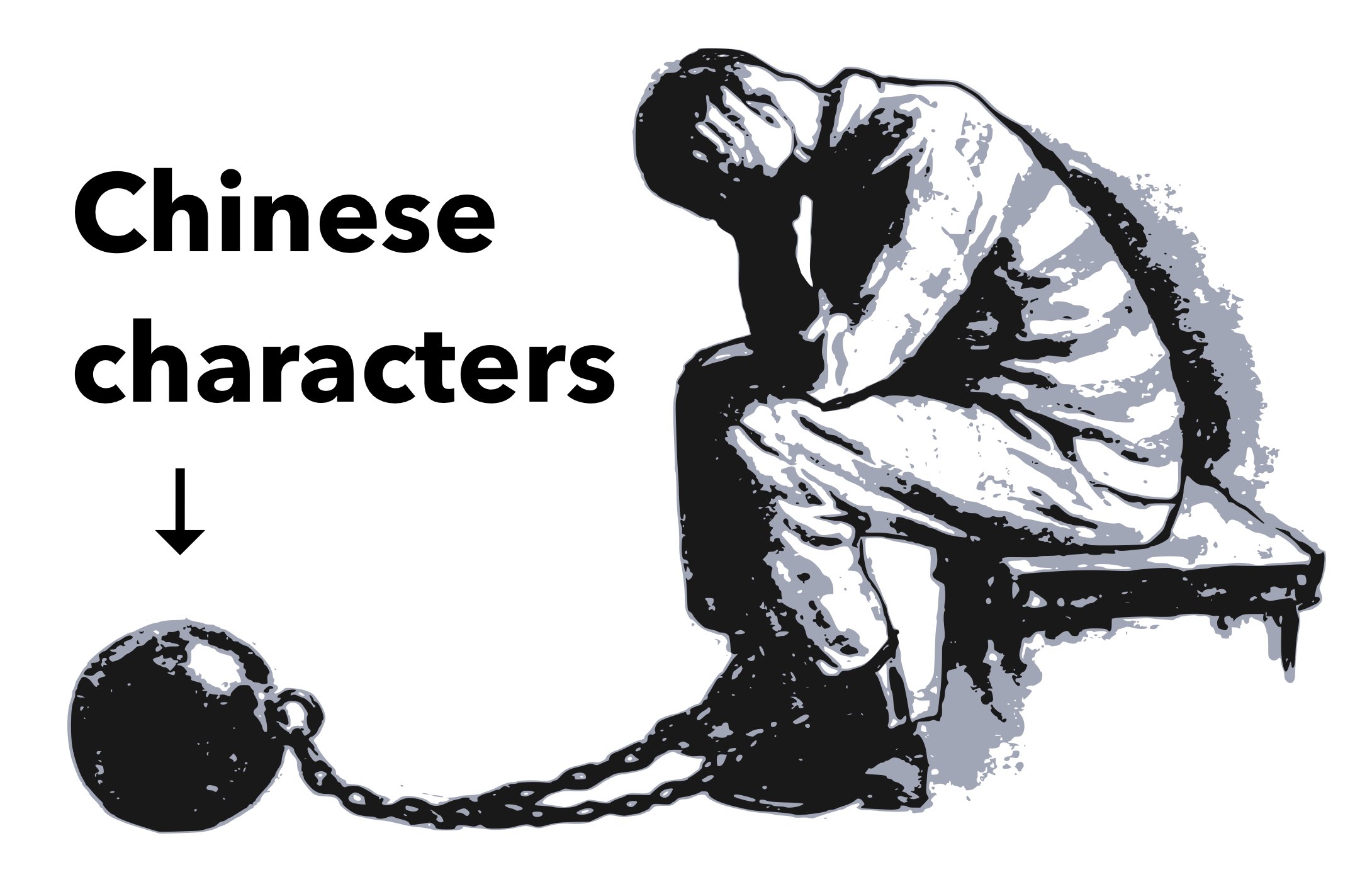

Chinese characters are a ball and chain made of human tradition.

Apparently, though, more and more Mandarin field language learners are getting used to seeing Pīnyīn being used on its own as the full writing system that it actually is, and not just as a pronunciation aid. Also, it seems that more and more Mandarin field language learners are gradually succeeding in actually getting familiar with Mandarin speech, resulting in them being able to appreciate more and more the rich meaning that has been baked into “just” Pīnyīn all along, since, as mentioned above, Pīnyīn is just a straightforward representation of Mandarin speech, and, as God’s Word itself says at 1 Corinthians 14:10, “no kind [of speech] is without meaning”.


At this point, it’s probably good to be reminded of what our primary goal as Mandarin field language learners should be, as shown by the above-mentioned scripture and some of its surrounding context:

“For if the trumpet sounds an indistinct call, who will get ready for battle? In the same way, unless you with the tongue use speech that is easily understood, how will anyone know what is being said? You will, in fact, be speaking into the air. It may be that there are many kinds of speech in the world, and yet no kind is without meaning. For if I do not understand the sense of the speech, I will be a foreigner to the one speaking, and the one speaking will be a foreigner to me.”—1 Corinthians 14:8–11.

Yes, it’s true that the world’s traditional Mandarin language instructors emphasize learning Chinese characters—all the better to perpetuate and glorify traditional worldly human Chinese culture, that many of them are quite proud of. However, what does Jehovah God himself say, our Grand Creator who actually invented human language and custom-designed our bodies to use it? He plainly tells us in his Word that in order to effectively share the good news and glorify God—not just some imperfect humans and their culture—in a foreign language, what we really need to master is actually that language’s “speech that is easily understood”.

A Default Twilight Zone?

In an effort to be in harmony with that basic principle, when Pīnyīn Plus material was first developed, its default setting was to show only Pīnyīn, which directly represents Mandarin speech—the Pīnyīn Plus “flashcards”, with the associated English translations, Chinese characters, etc., would only be shown when the user actively did something, like tap or click on a Pīnyīn expression or select the option to show all the “flashcards”. However, I was concerned that new users would never know to do something to display the “flashcards”, since many of them were probably used to how 3-line material (and pre-existing reading material in general) just shows all its available information all the time, without users having to do anything special after loading it. So, they might never realize that the kind of information that they were used to from 3-line material (even more information than that, actually) was available, and that it was just initially hidden to promote focus on the Pīnyīn and the Mandarin speech it represents.


To help clue users in to the fact that in Pīnyīn Plus material, “flashcards” full of rich language-learning information are available on demand for them to see, I added to the Pīnyīn Plus format the ability to mark, behind the scenes, certain selected relatively advanced Pīnyīn expressions, and I changed the initial default setting to show the “flashcards” for only these selected relatively advanced expressions when a page of Pīnyīn Plus material is loaded. (This is the 📄 Reveal Advanced setting, selectable at the top of each page of Pīnyīn Plus material.) This helps to give new users a taste of the rich information available in the Pīnyīn Plus “flashcards”, but it seems that it also puts Pīnyīn Plus material into what for some may be an unsatisfactory twilight zone.


On the one hand, 3-line material satisfies those who are used to seeing everything all the time, as was the only option in the old world of paper, from which 3-line material sprang. For example, English-speaking Mandarin learners who are just starting out on their Mandarin learning journeys undoubtedly find it comforting that the English lines are always visible, providing them a place of safety from which to dip their toes into the murky waters of Mandarin. 3-line material’s always-visible parallel lines also allow Mandarin learners of any level to get into a flow on any one of the available lines, and still instantly refer to one of the other lines as needed or desired. (However, some users find that always being presented with all the English, all the Pīnyīn, and all the Chinese characters is, well, a lot. Also, the always-visible English lines present a constant temptation to English-speaking users, for them to mentally just stay much of the time in the safe and comfortable domain of English. Thus, “getting into a flow” along the always-visible English lines can turn into “being in a rut”, and as time passes, the strange waters of Mandarin remain strange and murky, and never clear up.)


On the other hand, Pīnyīn-only material satisfies those who are used to seeing one writing system at a time (the vast majority of people, for all of their lives), and who have become familiar enough with the Pīnyīn writing system and the Mandarin speech that it represents that they don’t need or want to see anything else, even if they don’t understand some of the Mandarin expressions they encounter. In comparison, Pīnyīn Plus material, with its inline “flashcards” (some of which are visible by default), kind of forces people to occasionally mentally change gears and think about, for example, Mandarin and its meanings and how they relate to English and its meanings. People who are in learning mode and on the lookout for such information probably don’t mind this, and may even welcome this, but when people are just wanting to get through the material with a certain procedural goal in mind (e.g., “I just want to read this out”, or “I just want to follow along as someone reads this out”), they may find the visible inline “flashcards” intrusive.


(On the top of each page of Pīnyīn Plus material, there’s a dropdown menu that lets people choose the 📘 Reveal None setting, which thereafter causes no “flashcards”, and thus only Pīnyīn, to be shown, allowing for smooth, uninterrupted reading. However, as one writer put it, the way humans are, “for most users, the default value is the only value.” Also, even though the Introduction pages of Pīnyīn Plus resources have text that explains this available setting, experience shows that most people don’t read long blocks of text that explain a website, an app, etc. So, if you have gotten this far in this post, congratulations: You are exceptional! 👍🏼)

The Next Generation

With the above observations in mind, and to hopefully better satisfy those who are focused on Pīnyīn and the Mandarin speech it represents—who thus according to 1 Corinthians 14:8–11 are on the right track—I am starting to roll out the next generation of the Pīnyīn Plus format, which I am calling Pīnyīn+. (It’s Pīnyīn Plus—it’s even pronounced the same—but more compact and streamlined.) Pīnyīn+ builds on the Pīnyīn Plus format in the following ways:


Pīnyīn Plus:

  • This material is speech-first and mobile-first in design.
  • The default Pīnyīn text simply and directly represents Mandarin speech, which should be our main focus.—1 Corinthians 14:8–11.
  • Tapping/clicking on a Pīnyīn expression reveals a “flashcard” next to it showing its English meaning, Simplified character(s), Traditional character(s) (if they’re different), etc. Tapping/clicking on a “flashcard” or its Pīnyīn expression hides the “flashcard”.
  • More than one “flashcard” can be shown at a time.
  • 📖 📄 📘 icons mean 📖 Reveal All, 📄 Reveal Advanced, and 📘 Reveal None re all the “flashcards” in the heading, paragraph, etc. that they are placed at the beginning of.

Pīnyīn+:

  • By default, no “flashcards” are displayed, and a + symbol indicates an advanced expression with an available “flashcard”. This default setting is shown at the top of each page as ➕ Reveal + Symbols ”.
  • The 📘 Reveal None option causes “flashcards” and + symbols to not be displayed. (The 📄 Reveal Advanced option continues to be available for those who at least sometimes want to use it.)
  • Pīnyīn expressions not marked with a + symbol may or may not have a “flashcard”. More “flashcards” may be added over time.
  • 📖 📄 ➕ icons mean 📖 Reveal All, 📄 Reveal Advanced, and ➕ Reveal + Symbols re all the “flashcards” and + symbols in the heading, paragraph, etc. that they are placed at the beginning of.

The + symbols used in Pīnyīn+ material are kind of like the reference symbols (+*) used in the NWT Study Bible material in the Watchtower ONLINE LIBRARY, so hopefully that will help users understand them. Another change that is coming online with the Pīnyīn+ material is that in desktop browsers, the cursor will change to look like a hand with a pointing finger (something like 👆🏼) when it hovers over the 📖 📄 ➕ icons, over Pīnyīn expressions with a “flashcard”, and over revealed “flashcards”, showing that something will happen when these are clicked on.


Going forward, the overall plan is for any new material I produce to be in the new Pīnyīn+ format. Since Pīnyīn+ web pages can be added to existing Pīnyīn Plus web resources, these existing resources will become mixed Pīnyīn Plus / Pīnyīn+ resources for a time, as new Pīnyīn+ web pages are added and existing Pīnyīn Plus web pages are gradually updated to Pīnyīn+ format—easily identified by all the + signs—as time allows. (For example, as of this writing, Lesson 100 marks the beginning of the Pīnyīn+ material in the Learn From the Bible Bk. (Pīnyīn Plus / Pīnyīn+, Web) resource.)

It’s Better Now, But We’ve Just Scratched the Surface

The Blood brochure (hb) says that when someone suffers great blood loss, the first priority is to restore blood volume, and that “volume replacement can be accomplished without using whole blood”. Similarly, in the early days of the worldwide expansion of the Mandarin field that has brought us to the present day situation, many publishers who were not native speakers of Mandarin came to help in the Mandarin field, and helped to at least fill out the volume of people in the field. They often also brought a beneficial cultural breath of fresh air, and many Chinese people, both publishers and interested ones, could feel their out-of-this-world true Christian love, even if, especially in the beginning, their attempts at Mandarin were not always biāozhǔn (according to the standard)! (Proverbs 27:17; John 13:35; 17:16) Many such helpers from other language fields especially appreciated language-learning material like the 3-line material, with its always-visible lines showing pronunciation, meaning, and the official characters writing system, bundled by expression.


Eventually though, just as Jehovah designed the human body with mechanisms to build up the required number of actual oxygen-carrying red blood cells if they are lacking, the worldwide Mandarin field has eventually come to have more and more publishers in it who can actually understand and speak Mandarin fairly well, some of whom are native speakers and some of whom are language learners. Of course, due to the inhuman and inhumane complexity of the Chinese characters writing system, when faced with the Great Wall of Characters, even those who are fluent in Mandarin and relatively knowledgeable about characters regularly come across unfamiliar characters, or suffer from character amnesia.


The Great Wall of China

The Great Wall of Characters makes things unnecessarily highly difficult even for those who are relatively knowledgeable about characters.


Another factor to keep in mind is that while the Mandarin congregations and groups in nations that mostly speak English, Spanish, French, etc. seem to be doing well overall these days, we have still really only scratched the surface of the worldwide Mandarin field, since about 95%—yes, 95%—of the world’s Chinese people live in mainland China, where the preaching work has been restricted for a long time. (Matthew 13:38) Also, since there are about 2½ times as many people on earth whose mother tongue is Mandarin, compared to the number of people whose mother tongue is English, in a way, there should really be about 2½ times as many publishers in the worldwide Mandarin field as there are in the worldwide English field. Yes, it looks like there’s still a huge overall need for more Mandarin field publishers, including many more Mandarin field language learners.
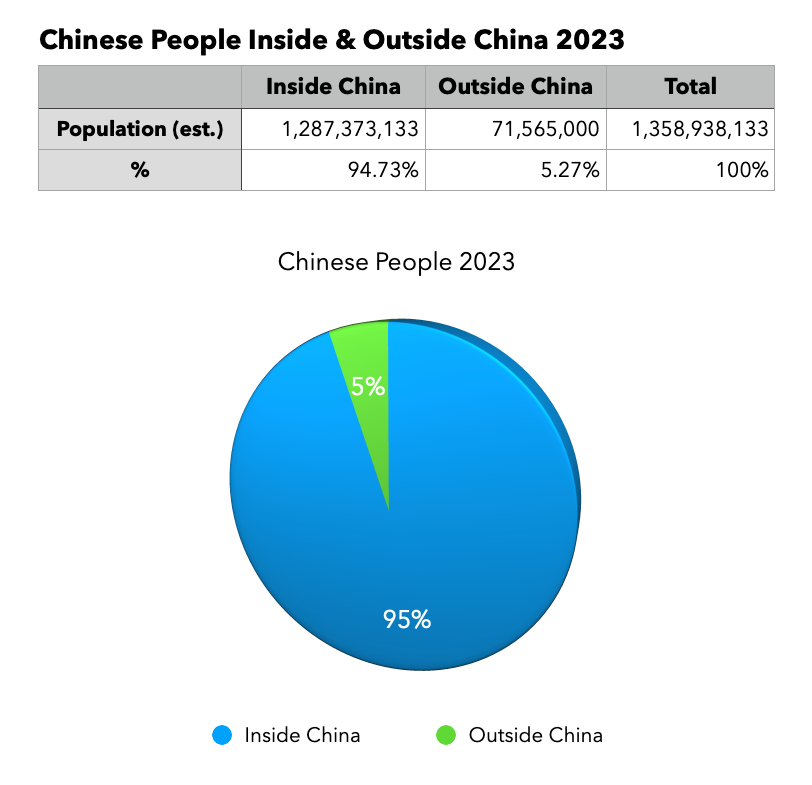

Screenshot of spreadsheet table and chart showing the estimated numbers of Chinese people inside & outside China in 2023

About 95% of the world’s Chinese people live in mainland China. (The above is from a spreadsheet which contains source links. A PDF file (with working source links) for that spreadsheet can be downloaded here.)
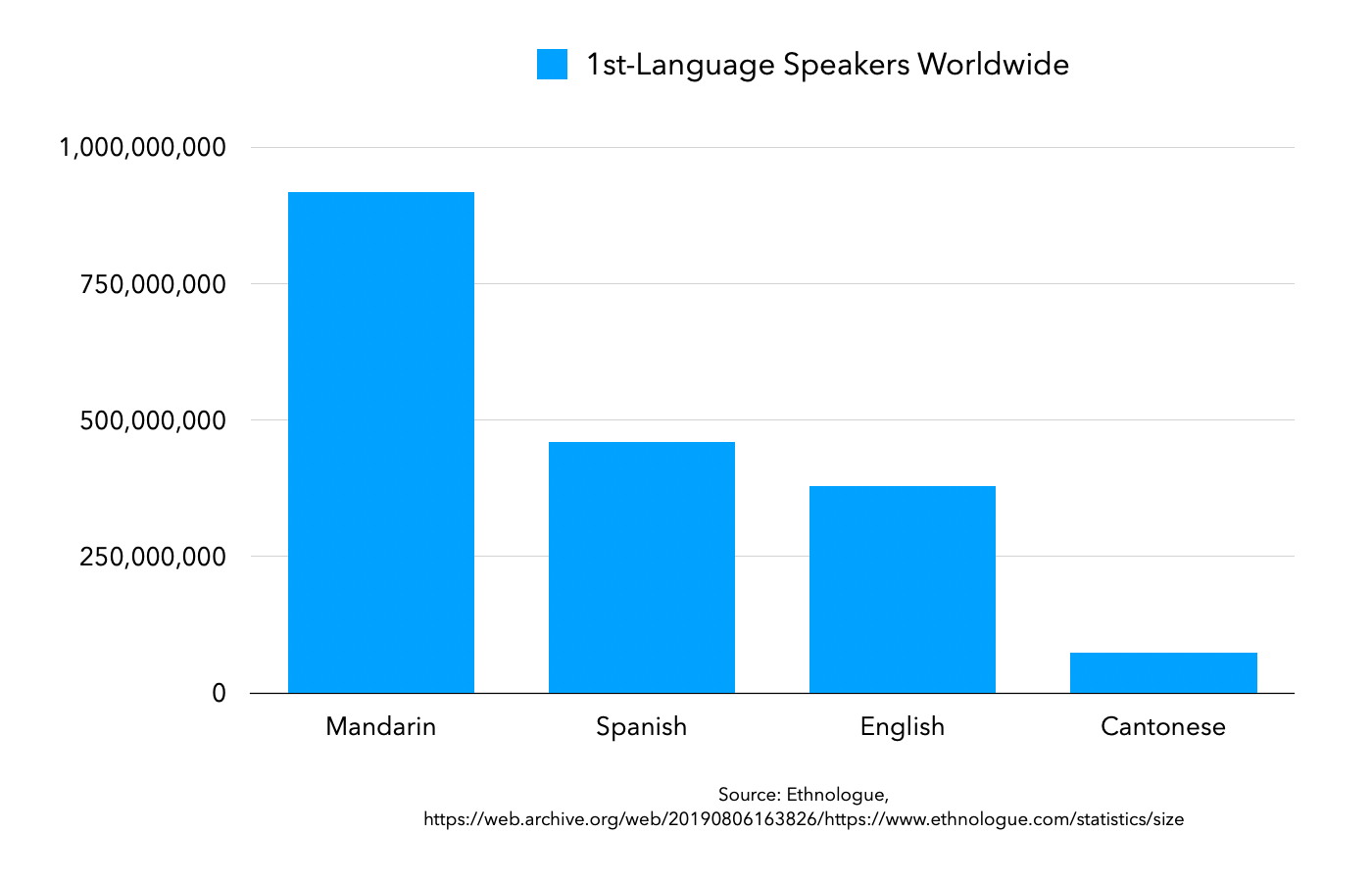

Chart: Languages by First-Language Speakers—2019

There are about 2½ times as many people on earth whose mother tongue is Mandarin, compared to the number of people whose mother tongue is English.


Pīnyīn+ material is optimized for the evidently growing number of Mandarin field language learners who are relatively used to Pīnyīn (or who are at least willing to try to get used to it), who have some familiarity with Mandarin speech (or who at least prioritize it), and who want a smooth reading experience. (In this respect, it is what people who are knowledgeable about software call “opinionated”. At least the opinion it embodies is one that Jehovah seems to share, as noted above, as opposed to just what is traditionally taught and accepted among humans in Satan’s world.) As a plus, rich language-learning information is also available on demand, marked by visible but fairly unobtrusive user interface affordances. Thus, language learners in the Mandarin field of any experience level, from beginner to advanced, can be helped to better understand and speak this language with the most people on earth for whom it’s their mother tongue, probably in all of human history. Hopefully, this new kind of material will prove helpful to both new and lifelong students of Mandarin in the massive worldwide Mandarin field in the time ahead, as Jehovah and Jesus continue to direct the work as they see fit.

Sunday, February 01, 2026

MEotW: yǔzhòu

The Mandarin Expression of the Week is:

How can we get Mandarin-speaking people thinking about whether the universe was designed?


Chart: Languages by First-Language Speakers—2019

The worldwide Mandarin field is by far the largest language field in the world, and it’s likely that it is the largest language field ever in history.


The Great Wall of China

In addition to the inherent technical difficulty of the subject of creation/evolution, Mandarin field language learners also face the Great Wall of characters.


Comments are enabled on this blog, so if you are so inclined, comment away!


A news feed for this blog is available here.


Sunday, October 12, 2025

MEotW: qià‐dào‐hǎochu

The Mandarin Expression of the Week is:

What can we say to Mandarin-speaking people about how fine-tuned the universe is to support life?


Comments are enabled on this blog, so if you are so inclined, comment away!


A news feed for this blog is available here.


Sunday, July 20, 2025

MEotW: Zàowù‐Zhǔ

The Mandarin Expression of the Week is:

Why is it especially important to talk to people in the Mandarin field about the evidence showing that the Creator exists?


Chart: Languages by First-Language Speakers—2019

The worldwide Mandarin field is by far the largest language field in the world, and it’s likely that it is the largest language field ever in history.


The Great Wall of China

In addition to the inherent technical difficulty of the subject of creation/evolution, Mandarin field language learners also face the Great Wall of characters.


Comments are enabled on this blog, so if you are so inclined, comment away!


A news feed for this blog is available here.


Sunday, June 22, 2025

MEotW: lìliang

The Mandarin Expression of the Week is:

Why is it especially important to talk to people in the Mandarin field about the impressive and moving ways in which Jehovah God uses his power?


Chart: Languages by First-Language Speakers—2019

Comments are enabled on this blog, so if you are so inclined, comment away!


A news feed for this blog is available here.


Saturday, December 21, 2024

MEotW: zǒuxiàn

The Mandarin Expression of the Week is:

How are some people in the Mandarin field’s territory like “sheep without a shepherd”?


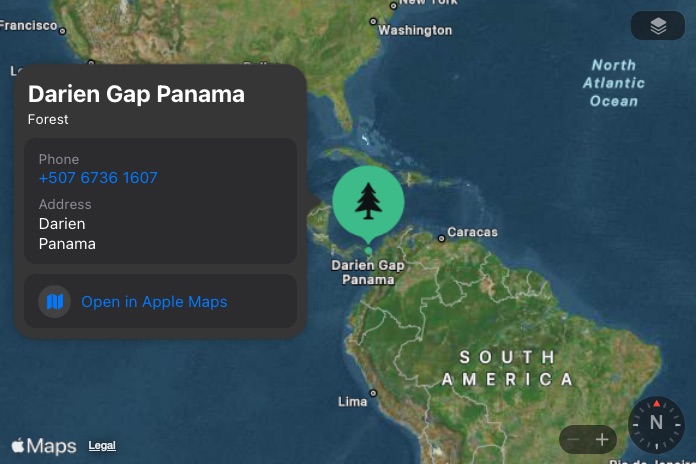
Screenshot of a map showing the Darién Gap

Comments are enabled on this blog, so if you are so inclined, comment away!


A news feed for this blog is available here.


Monday, April 07, 2014

Pīnyīn Was Plan A” Article Revised

Some revisions have been made to the article Pīnyīn Was Plan A”.


(The login information required is the same as for anywhere else on 3lines.org. If you’re already on the 3lines.org site, you can find this article in the folder Misc ▶ Articles.)


One of the changes made is that the quotations now have a light gray background to make it easier to tell them apart from the main text.


Here is an example of a portion of the article that has been rewritten:

Basically, compared to those in the standard program who were just taught Pīnyīn for a couple of months or so purely as a phonetic aid for pronouncing characters, the students who were allowed to use Pīnyīn on its own as a writing system for a couple of years or so not only did significantly better in learning the language and in learning the Chinese characters, they also did significantly better overall academically. This is not surprising to me, since language is needed to learn and progress in any and every other field of learning. As former UN interpreter Wu Wenchao said,

Chinese language is difficult to learn in comparison with alphabetic languages. …Chinese students work very hard and would have to spend two more years [some have said even longer] in learning in order to reach the same level of a Western intellectual. …The difficulty in learning is analogous to long boot-up time in computer terminology, which means system delay in becoming operational.

In view of the above, I can’t help but wonder how well those learning Mandarin for the Mandarin field can do who just keep on using Pīnyīn on its own as a writing system, instead of stopping and moving on to characters after some arbitrary length of time. Since Jehovah’s organization is now providing official Pīnyīn versions of the core publications, and since many unofficial Pīnyīn-containing resources are available as well (as discussed more extensively below), Pīnyīn-using Mandarin field language learners now actually do not have to divert years of additional time to learn the relatively complex Chinese characters. Also, they do not have to put forth additional constant, ongoing effort to remember the Chinese characters they’ve learned, and to learn new ones. (And if they do choose to learn some Chinese characters, they could do so more effectively than they could without the assistance of Pīnyīn.) Mandarin field language learners who just use Pīnyīn on its own as a writing system can focus more on the information being communicated in the publications, that they in turn need to communicate to those in the field, without having to expend so much time and mental effort on language technicalities. Such ones should do significantly better overall in the Mandarin field, just as the Z.T. students mentioned above did significantly better overall academically.

Sunday, November 17, 2013

Scripture Links, etc. Updated in “Pīnyīn Was Plan A” Article

The article Pīnyīn Was Plan A, which began as a post on the tiandi.info blog, has been updated so that the scripture links point to the new 2013 edition of the New World Translation on the WOL site. Some other tweaks have been made as well:


This article contains the results of much research and analysis about something that is of fundamental importance to our work in the Chinese field, so I encourage you to check out the current version, even if you have checked out the article before.


Monday, July 29, 2013

Pīnyīn Was Plan A” Now Available as an Article on 3lines.org

The article “Pīnyīn Was Plan A” is now available to be read on 3lines.org. This is a revised version of the tiandi.info post of the same name. Here is the link:

Pīnyīn Was Plan A”

(The login information required is the same as for anywhere else on 3lines.org.)

(If you’re already on the 3lines.org site, you can find this article in the folder Misc ▶ Articles.)

The subject of Pīnyīn and the Chinese characters may be one of the most important subjects I have ever written about, since it deals with facing the most difficult fundamental aspect of the Mandarin language, the language that is the very reason that the Mandarin field exists. This article contains much of the fruitage of months of research and analysis regarding this subject, and I highly recommend that anyone in or interested in the Mandarin field read it. Please feel free to pass on the information about this article to any Witness you know who fits that description. (Many of the principles discussed in this article apply to the Cantonese field as well, which is evidently consolidating on the Sidney Lau system as the romanization system of choice.)


Wednesday, January 30, 2013

Part of “Pinyin Was Plan A” tiandi.info Post Added To and Rewritten

Some of the material under the Meanwhile... subheading of the tiandi.info post “Pinyin Was Plan A” has been added to and rewritten.


Here is the current form of the section that was added to and rewritten:


The current reality is that it is good for those in the Chinese field to learn as many Chinese characters as they reasonably can. However, experience has shown that focusing too much on characters can cause one to get bogged down with their multifarious complexities and vagaries—while a picture may be worth a thousand words, it can take a thousand words or more to precisely describe a picture! All these complexities and vagaries can slow one’s progress in mastering other aspects of the language that are actually more important in the Chinese ministry. What other aspects are these? John DeFrancis, the linguist mentioned above, said in his book The Chinese Language: Fact and Fantasy that

Speech is primary, writing secondary

Meaning is ultimately carried in the sound of a language; writing mainly carries meaning not in itself, but because it represents the sound of the spoken word. This primacy of speech is not functionally or culturally poor or limiting, as held by some proponents of Hànzì and their contained meaning. Note what multiple award-winning composer and lyricist Stephen Sondheim (who wrote the lyrics for West Side Story) said about something that, like speech, is made up of sound alone:

Music is the richest of the arts because it’s the most abstract. And it is so filled with emotion.

Yes, speech is made up “only” of sound, but then so is music, which is merely the richest of the arts! Since it is so closely related to something that is the richest of the arts, it should come as no surprise that when it comes to language, “speech is primary”.

That means that understanding and speaking a language are even more important than reading and writing it. Indeed, understanding and speaking are the proper foundation upon which reading and writing must be built, not vice-versa. That is a basic fact about language, and about how Jehovah created us to learn and use language. For example, a baby naturally first learns to understand a few words, then one day it sees its father and says “Dada”. Only later does it learn to read and write the word “father”. A baby who writes out “father” before it ever said “Dada” would be most unusual!

Also, Jehovah built right into us the specialized equipment we need to directly produce speech, but we can only produce writing indirectly through the general purpose tools that are our hands, which generally must do so using man-made tools and media such as pens and keyboards and paper and computer screens. So, Jehovah himself supports that “speech is primary, writing secondary” in the very way he designed our bodies.

In our ministry specifically, we definitely need understanding and speaking much more than we need reading and writing, as important as they are. For example, a Japanese sister once explained to me that since Japanese writing uses many Chinese characters, Japanese people can often understand the meanings of Chinese characters that they read. However, the pronunciations of those characters are different in Japanese. So, before a Japanese publisher can be effective in the Chinese ministry, he must still first learn how to understand and speak Chinese—knowing the meanings of the characters is not enough. Think about it: When witnessing, what good is it for you to know the meanings of the characters in a scripture if you can’t

  • introduce it,

  • pronounce the words in it correctly when reading it out,

  • explain it understandably,

  • understand the student’s questions,

  • or answer the student’s questions effectively?

Conversely, we can often give a good witness just by understanding and speaking Chinese, even if the opportunity does not arise to read or write any Chinese while doing so.

In view of the above, it may be good to keep in mind the counsel in the January 15, 2011 Watchtower:

Jehovah’s Word urges us to “make sure of the more important things.” (Phil. 1:10) Likening the Christian life course to a long-distance footrace, under inspiration the apostle Paul recommended: “Let us also put off every weight . . . , and let us run with endurance the race that is set before us.” (Heb. 12:1) His point was that we must avoid needless pursuits, needless weights, that will tire us out. It may be that some of us are simply trying to squeeze too much into already busy lives. . . . Reasonableness and modesty should move all of us to recognize our limitations and keep unnecessary commitments to a minimum.

Yes, overemphasis on Chinese characters can be a burden that weighs us down rather than helping our progress in learning and using Chinese. And as the above counsel from The Watchtower emphasizes, we really do need to avoid things that weigh us down on the long-distance marathon of our Christian lives, let alone our long-term efforts to learn Chinese. Yes, to us it is indeed a significantly bad thing that Chinese characters are as hard to learn and remember as they are.


As it says in the recently posted update:


I have just rewritten some of the material under the Meanwhile… subheading of this post. Also, recently, I added Pinyin with tone marks for the Chinese names that were previously written only in English, without tone marks.

I continue to believe that the subject of this post is one of primary importance to those of us who are learning Mandarin for the Mandarin field, and I will likely continue to add to and tweak this post in the future.

I highly recommend coming back and rereading this post once in a while, both to catch any recent additions and tweaks, and also just to refresh your memory about this subject that is of primary importance in our language field.


Again, here is the link to the entire post:

“Pinyin Was Plan A”

To obtain the login information for tiandi.info, request e-mail notification of news regarding available resources, or if you have any questions or comments, you may e-mail me at waynerj@shaw.ca, providing information such as what group or congregation you’re with, who referred you to this site, etc.

Thursday, August 23, 2012

“Pinyin Was Plan A” tiandi.info Post Substantially Rewritten

The tiandi.info post “Pinyin Was Plan A” has been substantially rewritten. As it says in the recently posted update:

Since this post was originally posted back in January, I have been continuing to research and analyze this subject, since it is of such primary importance in the Chinese field. As one result of this ongoing research and analysis, this post has been substantially rewritten and updated, and a significant amount of material has been added to it. I highly recommend reading it in its current form even if you have already read the original post.

Especially noteworthy is the inclusion of examples cited by Zhou Youguang, who led the team that created pinyin, of Mandarin homophones that have had their pronunciations changed, thus resolving the potential confusion that could be caused by their previously identical pronunciations. This is some of the material added that shows that it is not correct to think that the number of homophones currently in Mandarin is a good reason not to use pinyin.


Also added is information about digraphia, such as the following:

Modern-day pinyin advocates generally see [pinyin totally replacing characters] as unrealistic, or at least very far off, and many of them, such as Victor H. Mair, do not call for that. However, many of them do call for pinyin to be accepted, not just as a pronunciation aid for the characters, but as the full-fledged script (writing system) for Mandarin in its own right that it linguistically qualifies as, and they call for pinyin to be taught, learned, and used as such a full-fledged script (writing system) in parallel with and with more or less the same status as the characters in a scenario known as digraphia (双文制 (shuāngwénzhì, “two-script system”).

The subject of pinyin and the Chinese characters may be one of the most important subjects I will ever write about on tiandi.info, since it deals with facing the most difficult fundamental aspect of the Chinese language, the language that is the reason the Chinese field exists. This rewritten post contains much of the fruitage of months of research and analysis regarding this subject, and I highly recommend that anyone in or interested in the Chinese field read it. Please feel free to pass on the information about this post to any Witness you know who fits that description.


To obtain the login information for tiandi.info, request e-mail notification of news regarding available resources, or if you have any questions or comments, you may e-mail me at waynerj@shaw.ca, providing information such as what group or congregation you’re with, who referred you to this site, etc.

Sunday, February 19, 2012

Breaking News: First Official Sidney Lau File Now Available

...is the title of a new post at tiandi.info. Here’s the text from the news feed:

A historic moment for the Cantonese field!

This tiandi.info post is about the historic news that the first official digital publication file with Cantonese Sidney Lau romanization is now available for download from jw.org. It is the file for the Sidney Lau version of the Bible Teach book.


To obtain the login information for tiandi.info, request e-mail notification of news regarding available resources, or if you have any questions or comments, you may e-mail me at waynerj@shaw.ca, providing information such as what group or congregation you’re with, who referred you to this site, etc.

Thursday, January 26, 2012

Pinyin and Zhuyin

...is the title of a new post at tiandi.info. Here’s the text from the news feed:

Is pinyin really less accurate than zhuyin? Which has been more effective at helping Mandarin-learners in the Chinese field? And, what does judo have to do with it?

To obtain the login information for tiandi.info, request e-mail notification of news regarding available resources, or if you have any questions or comments, you may e-mail me at waynerj@shaw.ca, providing information such as what group or congregation you’re with, who referred you to this site, etc.

Tuesday, January 10, 2012

Pinyin Was Plan A

...is the title of a new post at tiandi.info. Here’s the text from the news feed:

Pinyin was Plan A, so it’s not just training wheels for kids.

This post looks back at the original motives behind pinyin, and considers the value and potential value of pinyin in a world where written Chinese is still dominated by 漢字/汉字 (Hànzì), Chinese characters. (Make sure you don't miss the big footnote.)


To obtain the login information for tiandi.info, request e-mail notification of news regarding available resources, or if you have any questions or comments, you may e-mail me at waynerj@shaw.ca, providing information such as what group or congregation you’re with, who referred you to this site, etc.

Monday, September 05, 2011

Coolies and Quarterbacks

...is the title of a new post at tiandi.info. Here’s the text from the news feed:

Was Jesus a “coolie” or was he a “quarterback”? Yes.

To obtain the login information for tiandi.info, request e-mail notification of news regarding available resources, or if you have any questions or comments, you may e-mail me at waynerj@shaw.ca, providing information such as what group or congregation you’re with, who referred you to this site, etc.

Tuesday, April 12, 2011

Necessity, Invention, and Skunkworks Post Revised

The post “Necessity, Invention, and Skunkworks”, posted at tiandi.info a few hours ago, has just been revised to include some discussion about MEPS. Check it out!


To obtain the login information for tiandi.info, request e-mail notification of news regarding available resources, or if you have any questions or comments, you may e-mail me at waynerj@shaw.ca, providing information such as what group or congregation you’re with, who referred you to this site, etc.

Necessity, Invention, and Skunkworks

...is the title of a new post at tiandi.info. Here’s the description from the news feed:

The mother, births, upbringings, and adoptions of inventions in the Chinese field.

To obtain the login information for tiandi.info, request e-mail notification of news regarding available resources, or if you have any questions or comments, you may e-mail me at waynerj@shaw.ca, providing information such as what group or congregation you’re with, who referred you to this site, etc.

Monday, June 29, 2009

tiandi.info Map Now Uses the Google Earth Plug-in

The Map of Chinese Protogroups, Groups, and Congregations at tiandi.info has been enhanced with Google Earth Plug-in technology. This allows the current map file to be viewed, zoomed into, etc. right on the web page without having to be downloaded and opened in the Google Earth program. Of course, this option is still available for those who want the bigger view and other additional options offered by the full program.


Google Earth Plug-in content screenshot
A static screenshot of some Google Earth Plug-in content. The content on the Map page at tiandi.info is live and interactive, and it is bristling with placemarks representing Chinese protogroups, groups, and congregations all around the world.


An example of the power and resolution of Google Earth and the Google Earth Plug-in is that thanks to precise directions from a sister in the Nairobi Chinese Group in Kenya, this group’s placemark on the Map now points to the exact building in which it meets, the Nairobi Bethel Kingdom Hall.


To obtain the login information for tiandi.info, request e-mail notification of news regarding available resources, or if you have any questions or comments, you may e-mail me at waynerj@shaw.ca, providing information such as what group or congregation you're with, who referred you to this site, etc.

Friday, May 15, 2009

“The Cantonese Field...” tiandi.info Post Updated

The tiandi.info post “The Cantonese Field is Flourishing Along With the Mandarin Field” has been updated with a graphic representing the unique visitors to the Cantonese & Mandarin God’s Love book 3-line material download pages so far. These unique visitors total over 9,500 at this time. [More current versions of this file will be posted for download at the bottoms of the God’s Love book 3-line material pages as time allows.—ed., 2009-05-20]


I think it's especially interesting to look at the full size graphic at different zoom levels, from seeing the whole thing to zooming in until single rows are legible. It kind of lets you go from a “bird’s eye view” of this entire large army to a view from within the ranks. You, dear reader, are probably represented by one of the C’s or one of the M’s. If so, it is evident that you are not alone, and that Jehovah is mobilizing more and more workers for both the Cantonese field and the Mandarin field as the end draws ever closer.


To obtain the tiandi.info login information, request e-mail notification of news regarding available resources, or if you have any questions or comments, you may e-mail me at waynerj@shaw.ca, providing information such as what group or congregation you're with, who referred you to this site, etc.