MEotW: wénhuà
The Mandarin Expression of the Week is:
What if the Chinese word for “culture” didn’t come from Chinese culture?
Comments are enabled on this blog, so if you are so inclined, comment away!
A news feed for this blog is available here.

The Mandarin Expression of the Week is:
What if the Chinese word for “culture” didn’t come from Chinese culture?
Comments are enabled on this blog, so if you are so inclined, comment away!
A news feed for this blog is available here.
[NOTE: For spiritual food (which is for you yourself to learn spiritual things from, and which ideally should be in your own mother tongue), please go to jw.org.
The supplementary language-learning material mentioned in this post is for helping you to learn about how the Mandarin language is used in an official publication, so that you will be better able to help others in the Mandarin language field.]
The Jehovah’s Will (jl) brochure has been used on Bible studies for a long time, and it is now part of the Teaching Toolbox in the JW Library app. Unofficial previous-generation Pīnyīn and Pīnyīn-English material for it have been available for years, which material was based on an older version of the Jehovah’s Will brochure. Now, the following current-generation Pīnyīn Plus web material resource, based on the most recent 2016-11 Printing of the Mandarin Jehovah’s Will brochure, is available:

 can be used offline in supporting browsers, icon can be added to the home screen
In the above resource, material matching both the current 2016-11 Printing of the Mandarin Jehovah’s Will brochure and the current 2020 Printing (nwt) of the Mandarin NWT Bible is now available that covers the following:
Also available is the following material matching the current 2016-11 Printing of the Mandarin Jehovah’s Will brochure, in which the text of the 2016-11 Printing is different from the text of the previous printing:
Material with a grey background has been partially proofread. Pīnyīn material with a golden-hued background has been proofread, but not all of its “flashcards” have been added and proofread.
More current-generation Pīnyīn and Pīnyīn Plus material matching the current 2016-11 Printing of the Mandarin Jehovah’s Will brochure will be made available in the above resource as time allows.
(NOTE: While the organization expresses valid general concerns here about posting copies of official publications to the Internet, there are good legal and spiritual reasons for concluding that those concerns do not apply to this particular material, since such material should NOT be considered to be infringing on copyright, and since such material is specifically designed to be, NOT SPIRITUAL FOOD, but rather, material FOR LANGUAGE LEARNING. See this disclaimer for more information.)
[NOTE: For spiritual food (which is for you yourself to learn spiritual things from, and which ideally should be in your own mother tongue), please go to jw.org.
The supplementary language-learning material mentioned in this post is for helping you to learn about how the Mandarin language is used in an official publication, so that you will be better able to help others in the Mandarin language field.]
The Jehovah’s Will (jl) brochure has been used on Bible studies for a long time, and it is now part of the Teaching Toolbox in the JW Library app. Unofficial previous-generation Pīnyīn and Pīnyīn-English material for it have been available for years, which material was based on an older version of the Jehovah’s Will brochure. Now, the following current-generation Pīnyīn Plus web material resource, based on the most recent 2016-11 Printing of the Mandarin Jehovah’s Will brochure, is available:
can be used offline in supporting browsers, icon can be added to the home screenIn the above resource, material matching both the current 2016-11 Printing of the Mandarin Jehovah’s Will brochure and the current 2020 Printing (nwt) of the Mandarin NWT Bible is now available that covers the following:
Also available is the following material matching the current 2016-11 Printing of the Mandarin Jehovah’s Will brochure, in which the text of the 2016-11 Printing is different from the text of the previous printing:
Material with a grey background has been partially proofread. Pīnyīn material with a golden-hued background has been proofread, but not all of its “flashcards” have been added and proofread.
More current-generation Pīnyīn and Pīnyīn Plus material matching the current 2016-11 Printing of the Mandarin Jehovah’s Will brochure will be made available in the above resource as time allows.
(NOTE: While the organization expresses valid general concerns here about posting copies of official publications to the Internet, there are good legal and spiritual reasons for concluding that those concerns do not apply to this particular material, since such material should NOT be considered to be infringing on copyright, and since such material is specifically designed to be, NOT SPIRITUAL FOOD, but rather, material FOR LANGUAGE LEARNING. See this disclaimer for more information.)
[NOTE: For spiritual food (which is for you yourself to learn spiritual things from, and which ideally should be in your own mother tongue), please go to jw.org.
The supplementary language-learning material mentioned in this post is for helping you to learn about how the Mandarin language is used in an official publication, so that you will be better able to help others in the Mandarin language field.]
Nowadays, when we want to get a certain job done, many of us will reach for a smartphone or other computing device and look for a particular icon on the device’s home screen, since “there’s an app for that”. Now, Pīnyīn Plus web resources are beginning to adopt the ability of a Progressive Web App (PWA) to be installed on a user’s computing device and to add an icon to its home screen.
Combined with the ability to be used while offline (not connected to the Internet), this allows a suitably upgraded Pīnyīn Plus web resource to be launched from an icon on a computing device’s home screen and then just work like we have come to expect an app to work, even when the device is not connected to the Internet.
Installing a PWA and adding its website icon to your device’s home screen is simple. Instructions on how to add a PWA website’s icon to the home screen of an iPhone can be found here (at the bottom of the web page), and instructions on how to add a PWA website’s icon to the home screen of an Android phone using the Google Chrome web browser can be found here. On that same web page, instructions on how to add a PWA website’s icon on a Windows, Mac, or Linux PC-type computer using Google Chrome can be found here. (Recent desktop/laptop versions of the Microsoft Edge web browser work similarly, since they are now based on the same Chromium technology that desktop/laptop versions of Google Chrome are based on.) A chart showing what web browsers support this Add to home screen feature can be found here.
So far, the following Pīnyīn Plus web resources have been given the PWA-style ability to be installed on a computing device and to add an icon to its home screen:
can be used offline in supporting browsers, icon can be added to the home screen can be used offline in supporting browsers, icon can be added to the home screen
 can be used offline in supporting browsers, icon can be added to the home screen
 can be used offline in supporting browsers, icon can be added to the home screen
 can be used offline in supporting browsers, icon can be added to the home screen
As time allows, other Pīnyīn Plus web resources will also be enhanced with the ability to be installed on a computing device and to add an icon to its home screen.
The English meanings provided in Pīnyīn Plus inline “flashcards” can be much richer than the English meanings in past generations of Mandarin-learning material, since with Pīnyīn Plus material, the complete text of the English meanings does not have to be visible all of the time—it can stay out of sight and be not taking up space until you call for it. However, with all that rich information, sometimes including both literal meanings and effective meanings, the Pīnyīn Plus English meanings can sometimes get difficult to parse, or mentally divide into logical, digestible parts.
To make it easier to read and parse the rich Pīnyīn Plus English meanings, a new feature has been introduced that renders literal meanings that lead to effective meanings in a different colour, compared to the usual colour for English meanings. This different colour will have the same hue as the usual colour for English meanings, but it will be lighter, making the indicated material still identifiable as English material, even as it makes it easily distinguishable from the regular English material.
For example, with “yídìng (yí·dìng {(with) one} · {setting fixedly} → [definitely] 一定)”, it can be seen that the literal translations “{(with) one} · {setting fixedly}” lead to an effective meaning of “definitely”.
Pīnyīn Plus expressions in which the literal English meanings are understandable enough as they are will continue to display the English meanings in the usual colour for English meanings. An example of such an expression is “bāngzhù (help 帮助 幫助)”.
The practice of using different colours to distinguish different kinds of text has long been used in Chinese field unofficial language-learning materials, such as the 3-line materials, but this is apparently the first time different kinds of English-language material in such materials are being rendered in different—though related—colours.
Those who work with computer source code, like web developers and app developers, also take advantage of how quickly and easily humans can generally tell different-coloured items apart from one another, by having the different parts of the source code they work with displayed in different colours. That way, that often complex source code can be much more easily made sense of by humans. This practice is called syntax highlighting.
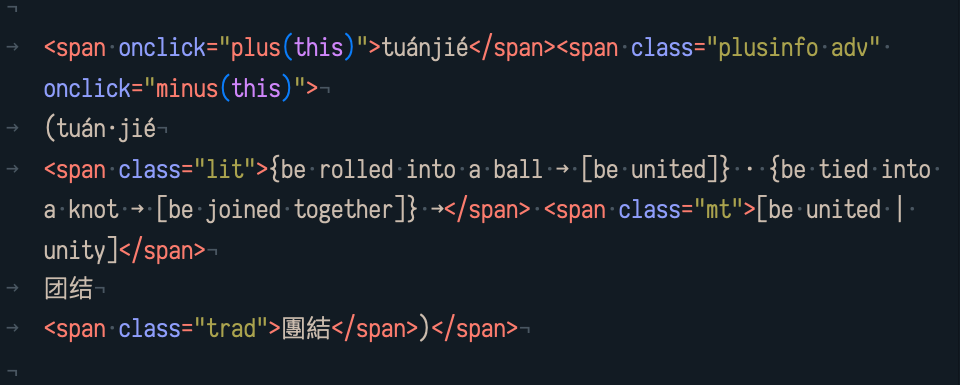
Syntax highlighting example: Some Pīnyīn Plus web page source code involved in rendering the Mandarin expression “tuánjié”
Another change that is being made to improve Pīnyīn Plus material English meanings is that the capitalization formats applied to the English meanings are now being made to match the capitalization formats of the Pīnyīn expressions they are attached to—if the Pīnyīn is all capitals, the English will be all capitals; if the Pīnyīn is in title case, the English will be in title case, etc. (One exception is that the punctuation-motivated capitalization of the first Pīnyīn word of each sentence will not be carried over to its corresponding English meaning, since the English meanings do not include punctuation.)
The above changes to how Pīnyīn Plus material English meanings are rendered will be implemented in all new Pīnyīn Plus material going forward. Existing Pīnyīn Plus material will be revised with these changes as time allows.
The Mandarin Expression of the Week is:
What do the different ways of writing “love” in Traditional Chinese characters, Simplified Chinese characters, and Pīnyīn tell us about these writing systems?
“愛” is the Traditional Chinese character for “love”. It appropriately has the “heart” radical (“心”) in it, but it’s quite…complicated. 😓
— Troubadour WW (@troubadourww) February 20, 2017
Comments are enabled on this blog, so if you are so inclined, comment away!
A news feed for this blog is available here.
[NOTE: For spiritual food (which is for you yourself to learn spiritual things from, and which ideally should be in your own mother tongue), please go to jw.org.
The supplementary language-learning material mentioned in this post is for helping you to learn about how the Mandarin language is used in an official publication, so that you will be better able to help others in the Mandarin language field.]
The Jehovah’s Will (jl) brochure has been used on Bible studies for a long time, and it is now part of the Teaching Toolbox in the JW Library app. Unofficial previous-generation Pīnyīn and Pīnyīn-English material for it have been available for years, which material was based on an older version of the Jehovah’s Will brochure. Now, the following current-generation Pīnyīn Plus web material resource, based on the most recent 2016-11 Printing of the Mandarin Jehovah’s Will brochure, is available:
can be used offline in supporting browsers,In the above resource, material matching both the current 2016-11 Printing of the Mandarin Jehovah’s Will brochure and the current 2020 Printing (nwt) of the Mandarin NWT Bible is now available that covers the following:
Also available is the following material matching the current 2016-11 Printing of the Mandarin Jehovah’s Will brochure, in which the text of the 2016-11 Printing is different from the text of the previous printing:
Material with a grey background has been partially proofread. Pīnyīn material with a golden-hued background has been proofread, but not all of its “flashcards” have been added and proofread.
More current-generation Pīnyīn and Pīnyīn Plus material matching the current 2016-11 Printing of the Mandarin Jehovah’s Will brochure will be made available in the above resource as time allows.
(NOTE: While the organization expresses valid general concerns here about posting copies of official publications to the Internet, there are good legal and spiritual reasons for concluding that those concerns do not apply to this particular material, since such material should NOT be considered to be infringing on copyright, and since such material is specifically designed to be, NOT SPIRITUAL FOOD, but rather, material FOR LANGUAGE LEARNING. See this disclaimer for more information.)